
 Call Now
 Programs
  About
About 

Revenue Analytics: Key Aspects, Software, Examples, Responsibilities & Salaries
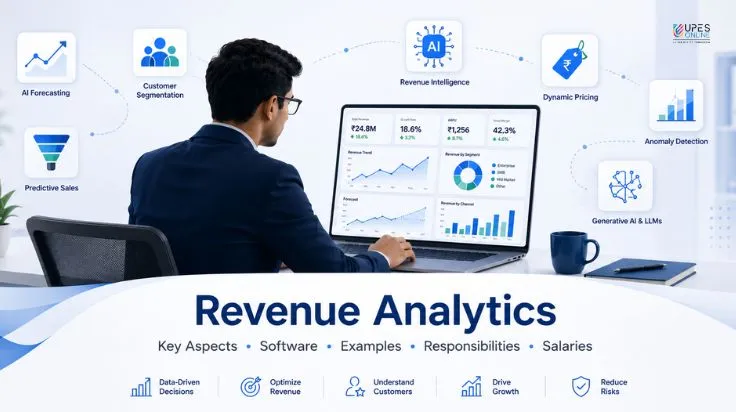
Revenue Analytics has emerged as a critical function in modern business, allowing organizations to move beyond intuition and make data-driven decisions that directly impact growth and profitability. By combining data analytics, finance, marketing, and technology, it provides a comprehensive and focused view of how revenue is generated, optimized, and sustained. By forecasting future trends to understanding customer behavior and refining pricing strategies, analytics powered by several revenue analytics software empowers businesses to stay competitive in unpredictable markets. As industries increasingly adopt digital and AI-driven approaches, mastering the concepts and tools has become essential for professionals and aspiring business leaders alike. In this article, we will discuss what is the meaning of revenue analytics; we will check out some real-world examples and figure out what does a revenue analyst do.
What is the Meaning of Revenue Analytics?
Revenue Analytics is a business practice where businesses utilize raw data, statistical methods, and revenue analytics software to analyze, predict, and optimize revenue channels. The analysis typically involves tracking and measuring metrics such as pricing, demand, customer behavior, and sales history to make informed business decisions. While largely a branch of Data Analytics, on a larger scale this analytics includes concepts of Finance, Marketing, and Brand Strategy.
| Revenue Analytics | Quick Facts |
|---|---|
| Primary Goal | Revenue Growth |
| Used By | Finance, Marketing, Sales |
| Key Tools | Power BI, Tableau, Salesforce |
| Skills | SQL, Excel, Statistics |
| Industries | Retail, SaaS, Banking |
| Career Scope | High Growth |
Different Aspects of Revenue Analytics
The function of Revenue Analytics is not limited to analyzing profits and losses of a business; rather, it helps businesses by analyzing different aspects of a business in making a data-driven decision:
| Particulars | Function |
|---|---|
| Revenue Forecasting |
|
| Pricing Analytics |
|
| Customer Analytics |
|
| Sales & Channel Analytics |
|
| Demand Analytics |
|
| Marketing & Campaign Analytics |
|
| Revenue Operations |
|
| Profitability & Margin Analysis |
|
| Predictive & Prescriptive Analysis |
|
| Risk Analysis |
|
Revenue Analytics vs Business Analytics vs Financial Analytics
Revenue, financial and business analytics are part of the same umbrella but differ in their core operation. See how:
| Revenue Analytics | Business Analytics | Financial Analytics |
|---|---|---|
| Revenue optimization | Business performance | Financial performance |
| Pricing | Operations | Accounting |
| Sales | Strategy | Investments |
Industry-Wise Real Word Revenue Analytics Examples
As businesses adopt data-driven approaches to deliver services, target new customers, and retain existing ones, companies across industries are increasingly leveraging Revenue Analytics to optimize their revenue streams. Here are some real-world examples from three distinct industries:
Travel and Hospitality Industry
Travel and Hospitality industries are highly influenced by customer behavior and trends. Analytics helps these industries to not only make informed decisions but also helps them offer personalized services to their repeat customers.
- Airlines like Indigo and Air India use price analytics to implement dynamic pricing. This allows companies to change ticket fairs in real-time based on demand, seat availability, and timing.
- Similarly, hotel chains also utilize price analytics to determine prices for rooms based on seasonality, demand, and events. Furthermore, hotels may also use historical data to offer discounts or personalized services to repeat or member customers.
E-Commerce Industry
Predictive analytics and demand analytics are major parts of the E-Commerce industry. Leading e-commerce platforms utilize analyzed data to determine price, inventory, and revenue optimization.
- E-commerce platforms such as Amazon, Flipkart, and Myntra analyze customer behavior to pitch recommended products.
- This helps e-commerce platforms to have dynamic pricing models, which are influenced by events and demand.
- Furthermore, advanced predictive & prescriptive analysis helps e-commerce platforms to predict a customer’s purchasing behavior and recommend services accordingly.
Entertainment & Digital Media Industry
Over the top media platforms (OTTs) utilize customer analytics to not only understand revenue patterns but also personalize servicesvices, recommend content, as per user behavior, and improve customers retention rates.
- Streaming platforms such as Netflix uses price analytics to offer suitable subscription prices.
- OTT platforms also use the analytical metrics to recommend content and reduce churn.
Benefits of Revenue Analytics for Businesses
In modern business scenarios, Revenue Analytics plays a crucial role for a business in determining their growth strategies, budgeting, and planning revenue allocations efficiently. The following are some of the key benefits for businesses:
- Smarter Pricing Decisions: Different analytical aspects allow businesses to understand user behavior, purchasing patterns, high paying customers, profit generating services, etc. These metrics allow businesses to make smarter pricing decisions, offering discounts, pitching subscriptions, and recommend products.
- Improved Forecasting: Businesses utilize past revenue trends to analyze and forecast efficient revenue prospects. Additionally, the analytics allow businesses to identify revenue-generating factors and make informed business decisions.
- Customer Segmentation: Utilizing customer analytics and predictive analysis, businesses can group their customers into different segments and offer customized services.
- Revenue Optimization: A detailed analysis of overall profits & loss can help businesses identify what works and what doesn't. This helps in crafting effective policies, deciding on appropriate pricing, higher conversion, and retention rates.
- Better Decision-Making: With accessibility to detailed data-driven reports and information, leaders can make strategic decisions that result in growth without making a guesswork.
Revenue Analytics Software
Revenue Analytics Software are programs designed for organizations to turn business insight into valuable data-rich information. Typically, a Revenue Analytics or Management Software collects data from different functions of the business such as sales, market, prices, and finance, and turns it into actionable insights for leaders. For aspiring business managers and analysts, learning about these programs is essential, as they streamline business operations by providing actionable reports and recommendations on driving sales and revenue.
These programs help business leaders answer questions such as where the revenue is coming from? Which customers or products are the most profitable, and what steps are needed to increase sales, and ultimately make an informed decision to improve business performance.
How does Revenue Analytics Software Work?
Typically, analytical software works by processing historical data and analyzing sales patterns. The process of a Revenue Analytics Software can be described as per the following:
- 1. Collecting and processing data: The program collects data from different channels such as CRM, ERP, and marketing platforms and processes the same.
- 2. Data analysis: Through available analytics or by utilizing AI technologies, the program analysis data against different aspects.
- 3. Visualize insights: Through interactive dashboards and reports, the program generally produces insights that provide a clear picture of the live status of different business functions.
- 4. Predict future revenue trends: Based on produced insights and analyzed data, the program then predicts the revenue forecast for the upcoming session.
- 5. Recommend actions: Furthermore, the software can also recommend required actions to improve sales performance or conversion rates by identifying high-revenue making channels.
Best Revenue Analytics Software 2026
The following is a list of widely used revenue analytics software.
- Metria
- HubSpot Sales Hub
- ProftWell
- Salesforce Revenue Cloud
- Zenskar
Industries Using Revenue Analytics
Revenue analytics is used across industries where pricing, demand, customer behaviour, margins, and sales performance directly affect business growth.
1. SaaS and Technology
- SaaS companies analyse monthly recurring revenue, annual recurring revenue, customer acquisition cost, lifetime value, churn, renewals, and upselling opportunities.
2. Retail and E-commerce
- Retailers use revenue analytics for product pricing, inventory planning, customer segmentation, campaign performance, recommendation systems, and seasonal demand forecasting.
3. Banking and Financial Services
- Banks and financial institutions analyse product profitability, customer value, fee income, cross-selling, risk-adjusted returns, and branch or digital-channel performance.
4. Travel, Aviation, and Hospitality
- Airlines, hotels, and travel companies use dynamic pricing, occupancy forecasting, route profitability, booking behaviour, and demand analytics to maximise revenue.
5. Media, Entertainment, and OTT
- Subscription-based platforms analyse audience engagement, churn, content performance, advertising revenue, pricing plans, and customer retention.
6. Telecom
- Telecom companies use revenue analytics to study average revenue per user, plan adoption, churn risk, data usage, customer lifetime value, and network-related revenue opportunities.
7. Healthcare
- Hospitals, health-tech companies, and insurers analyse service demand, patient revenue, capacity utilisation, pricing, claims, and payer performance.
8. Manufacturing
- Manufacturers use analytics to evaluate product margins, customer profitability, demand cycles, distributor performance, pricing, and contract efficiency.
9. Insurance
- Insurers analyse premium income, policy renewals, claims ratios, customer segments, channel profitability, and product performance.
10. EdTech and Online Education
- Education platforms use revenue analytics to monitor lead conversion, programme demand, student acquisition cost, fee realisation, renewals, and campaign ROI.
11. Consulting and Professional Services
- Consulting firms track project revenue, utilisation, billable hours, client profitability, pricing, and revenue forecasts.
12. Consumer Goods and FMCG
- FMCG companies analyse product-wise revenue, distributor performance, regional demand, trade promotions, pricing, and market-channel profitability.
How AI is Transforming Revenue Analytics
Artificial Intelligence (AI) is changing the way businesses understand and grow their revenue. Instead of relying only on past sales reports, AI helps companies predict future demand, understand customer behaviour, identify revenue opportunities, and make faster, smarter business decisions.
1. AI Forecasting
- AI studies past sales, seasonal trends, customer behaviour, and market conditions to predict future revenue more accurately. These insights help businesses plan budgets, manage inventory, hire the right talent, and prepare for future demand.
2. Dynamic Pricing
- Have you noticed how flight tickets or hotel prices change every day? That's AI at work. AI-powered pricing systems automatically adjust prices based on demand, competition, inventory, and customer interest. Industries like airlines, hotels, e-commerce, and ride-hailing apps use this to maximise revenue.
3. Customer Segmentation
- Not every customer is the same. AI groups customers based on their buying habits, interests, spending patterns, and engagement. Businesses can then offer personalised recommendations, targeted discounts, and loyalty rewards to improve customer satisfaction and sales.
4. Predictive Sales
- AI helps sales teams identify which leads are most likely to become customers and which existing customers may purchase again or upgrade. This allows businesses to focus on high-value opportunities instead of spending time on unlikely prospects.
5. Generative AI and LLMs
- Generative AI Tools like ChatGPT and other Large Language Models (LLMs) are making revenue analysis much easier. They can summarise dashboards, explain sales trends, generate reports, answer business questions, and help teams analyse data using simple, everyday language. However, human review is still important before making business decisions.
6. Revenue Intelligence
- Revenue intelligence platforms bring together data from sales, marketing, finance, and customer support into one dashboard. AI then identifies growth opportunities, predicts revenue gaps, highlights deals that may not close, and suggests ways to improve customer retention and increase sales.
7. Anomaly Detection
- AI can quickly detect unusual changes in sales, pricing, customer behaviour, or billing. For example, it can alert businesses if sales suddenly drop, discounts are being misused, or there are signs of fraud. Detecting these issues early helps prevent revenue loss and improves decision-making.
AI is not replacing revenue analysts but making them more effective. By automating repetitive tasks and analysing large volumes of data in seconds, AI allows professionals to spend more time solving business problems, improving strategies, and making smarter decisions to drive business growth.
Top Revenue Analytics Jobs with Salaries in India
In the current business space, where data is invaluable for growth and brand positioning, the scope of revenue analytics in the job market is vast with several available opportunities. The following are some of the most sough-after careers along with average revenue analytics salary:
| Job Title | Average Package |
|---|---|
| Average Package | 9.45 LPA |
| Pricing Analyst | 13.33 LPA |
| Revenue Operation (RevOps) Analyst | 14.6 LPA |
| Business Analyst (Revenue/Growth) | 10 LPA |
| Financial Analyst (Revenue) | 16.8 LPA |
Skills Recruiters Look for in Revenue Analysts
Revenue analysts need a combination of technical, financial, and business skills. Employers typically look for professionals who can analyse data and explain how it should influence pricing, sales, customer strategy, and profitability.
| Skill | Why It Matters |
|---|---|
| Excel and Spreadsheets | Used for financial modelling, forecasting, scenario analysis, and quick reporting |
| SQL | Helps extract, combine, and validate data from sales, finance, CRM, and customer databases |
| Power BI or Tableau | Used to build revenue dashboards and communicate performance clearly |
| Python or R | Supports predictive modelling, automation, segmentation, and advanced analysis |
| Statistics and Forecasting | Essential for identifying trends, testing assumptions, and estimating future revenue |
| Pricing Analytics | Helps assess price elasticity, discounting, competitor pricing, and margin impact |
| Financial Acumen | Enables analysts to understand revenue, costs, margins, profitability, and cash-flow implications |
| CRM and Revenue Tools | Familiarity with platforms such as Salesforce and HubSpot helps analyse pipelines and customer journeys |
| Business Communication | Recruiters value analysts who can translate complex findings into clear recommendations |
| Commercial Thinking | Strong analysts connect data with customer behaviour, market conditions, and business goals |
| AI Literacy | Understanding AI forecasting, copilots, anomaly detection, and model limitations is increasingly valuable |
A strong candidate should be able to show a portfolio containing a revenue dashboard, forecast model, pricing analysis, customer segmentation exercise, or insight memo.
Why Revenue Analytics is an Essential Skill in 2026
In current business dynamics, where new marketplaces are emerging every day, it is becoming more important for businesses to adapt to changing customer demands and behaviors. Revenue analytics today have shifted from a specialized back-office function to an integral strategic business necessity. Furthermore, integration of artificial intelligence into business functions, technological developments, unpredictable demands, and data-driven approaches, allows businesses to forecast, manage, and optimize revenue to maximize profitability and ensuring that they remain ahead of their competitors.
Therefore, in this context, a good understanding of revenue analytics for its applications and revenue analytics software offers students pursuing an MBA in Business Analytics as an extra advantage. Businesses today are not only looking for professionals who can read and interpret data, but also can strategize, implement, and maximize their profitability by utilizing advanced technical approaches.
FAQs
Is Revenue Analytics a good career?
- Yes, Revenue Analytics is an excellent career choice in 2026 with a highly lucrative career path. As companies across the globe rely on data for revenue forecasting, budget planning, optimize pricing, and maximize profitability, demand for managers who cannot just interpret data but also can strategies and implement data-backed financial decisions. Some of the top roles that graduates can pursue include Revenue Analyst, Sales Operations Analyst, and Revenue Operations Manager.
Which Revenue Analytics software is best?
- While there are several software and programs available for managers, the best pick depends on the requirement and particular use-cases. While HubSpot is best for CRM-native pipeline analytics, ProfitWell is best for free SaaS subscription metrics, and Zenskar and Salesforce are superior for complex, enterprise-grade, usage-based billing and revenue operations.
Is Revenue Analytics part of Business Analytics?
- Yes, Revenue Analytics is an important part of Business Analytics with a focus on sales performance, pricing strategies, and customer behavior to optimize income generation.
Do Revenue Analysts use AI?
- Yes, Revenue Analysts use artificial intelligence technology in several key areas such as automate data cleaning, improving forecasting accuracy, and surface pricing insights. While AI does not replace an analyst, it works as a smart assistant for automating manual workflows.
Revenue Analytics vs Revenue Operations?
- Revenue Analytics and Revenue Operations (RevOps) are closely related but serve different purposes in a business. Revenue Analytics focuses on analyzing data from sales, marketing, and customer activities to understand what is driving revenue growth and to predict future business performance. Revenue Operations (RevOps), on the other hand, is about bringing different teams, such as sales, marketing, and customer success, together by using shared processes, tools, and data.
UPES Online Admission Enquiry
Recommended Courses




Latest Blogs

Online B.Com Scope in 2026: Benefits, Careers, Salaries & Is It Worth It?
Explore online B.Com scope in 2026, including benefits, career options, salaries, industries, higher studies and whether an online B.Com degree is worth it.
Read MoreJul 31, 2026 I 11 mins
MBA for Working Professionals: Eligibility, Fees, Specializations & Career Scope
Explore a detailed guide on MBA for working professionals including eligibility, fees, online MBA options, top specializations, career scope & how to apply.
Read MoreAug 15, 2026 I 13 mins
Is Online MCA Worth It in 2026? Fees, Eligibility, Jobs & Colleges
Find out whether an Online MCA is worth it in 2026. Explore eligibility, fees, specializations, colleges, career scope, salaries and UGC validity.
Read MoreAug 29, 2026 I 11 mins
Online MBA for Engineers: Specializations & Career Scope
Find out if online MBA for engineers is a good choice; explore top specializations and career scope.
Read MoreSep 8, 2026 I 11 mins
How to Identify Online Fake Universities & Degree Scams
Check the UGC fake university list 2026 and learn how to verify an online university, course entitlement, and whether a degree certificate is original or fake.
Read MoreSep 23, 2026 I 10 mins
How to Become a Project Manager with Online MBA in India: Detailed Guide
Learn how to become a project manager in India, including qualifications, skills, certifications, salary, career path & how an Online MBA can support it.
Read MoreSep 28, 2026 I 10 mins
Top Reasons to Pursue Online MBA in Finance
Explore top 10 benefits of an online MBA in Finance, including flexibility, finance skills, career opportunities, salaries, and who should pursue it.
Read MoreSep 29, 2026 I 10 mins
Related Articles
Prescriptive Analytics: Using Data to Make Better Decisions
Learn types of prescriptive techniques & examples of prescriptive analytics to make data analytics & business analysis a detailed & accurate process.
Read Blog
Data Analytics: Turning Data Into Insights and Action
Discover latest data analytics techniques & tools to extract meaningful information from complex data sets & make data-driven decisions.
Read Blog
Web Analytics: Tracking & Analyzing Website Data
In this blog find answers to what is web analytics? What is web analytics process? What is the importance of website analytics?
Read Blog
Text Analytics: Analyzing Text Data to Extract Meaning and Insights
Learn about successful techniques & tools for text mining, text analytics & types of text analytics to derive most insightful data interpretations.
Read BlogPrescriptive Analytics: Using Data to Make Better Decisions
Learn types of prescriptive techniques & examples of prescriptive analytics to make data analytics & business analysis a detailed & accurate process.
Read BlogData Analytics: Turning Data Into Insights and Action
Discover latest data analytics techniques & tools to extract meaningful information from complex data sets & make data-driven decisions.
Read BlogWeb Analytics: Tracking & Analyzing Website Data
In this blog find answers to what is web analytics? What is web analytics process? What is the importance of website analytics?
Read BlogText Analytics: Analyzing Text Data to Extract Meaning and Insights
Learn about successful techniques & tools for text mining, text analytics & types of text analytics to derive most insightful data interpretations.
Read Blog