 Call Now
 Programs
  About
About 

Generative AI: Unveiling the Magic of Machine Creation

The realm of artificial intelligence (AI) is constantly expanding, pushing the boundaries of what machines can do. At the forefront of this evolution stands Generative AI, a subfield focused on creating entirely new content, ranging from text and images to music and code. This comprehensive guide delves into the captivating world of Generative AI, unveiling its secrets, exploring its applications, and pondering its potential impact on the future.
What is Generative AI?
Generative AI encompasses a multitude of techniques and models trained on vast datasets of existing content. By analyzing patterns and relationships within this data, these models learn to "understand" the underlying structures and rules governing its creation. Armed with this knowledge, they can then generate entirely new content that mimics the style, format, and characteristics of the training data.
This process isn't simply copying or replicating existing content. Instead, Generative AI models use their understanding to invent novel variations, combinations, and even completely original concepts. Imagine an AI trained on countless musical pieces that can then compose a never-before-heard symphony, or a model studying art styles that can paint a masterpiece in a completely new genre.
Techniques of Generative AI
The magic of Generative AI lies in its diverse toolset. Let's explore some of the most captivating techniques:
1. Generative Adversarial Networks (GANs):
Imagine two AI models playing a game. One, the generator, crafts new content, while the other, the discriminator, tries to distinguish it from real data. This adversarial training pushes the generator to create ever-more convincing simulations, leading to incredibly realistic results.
2. Variational Autoencoders (VAEs):
These models compress information into a latent space, a low-dimensional representation of the key features of the data. By manipulating this latent space, VAEs can generate variations of the original data or even synthesize entirely new content from scratch.
3. Transformer-based architectures:
Inspired by the way humans translate languages, these models excel at understanding and mimicking complex relationships within data. They are particularly adept at generating coherent and creative text formats.
Applications of Generative AI
The potential applications of Generative AI are truly limitless. We've already witnessed its impact in various fields:
1. Art and Design: Creating stunning visuals, generating custom music, and even designing furniture and architecture—Generative AI is shaping the creative landscape.
2. Media and Entertainment: From producing personalized news articles to writing captivating scripts and even generating realistic special effects, Generative AI is revolutionizing storytelling.
3. Science and Research: Accelerating drug discovery, designing new materials, and even generating hypotheses for scientific inquiries – Generative AI is pushing the boundaries of knowledge.
4. Healthcare: Personalizing medical treatments, analyzing medical images, and even assisting in surgery – Generative AI is transforming healthcare practices.
Types of Generative AI Tools
Generative AI tools can be categorized based on the type of content they generate:
- Text-to-Text Generators: These tools create text formats such as articles, code, scripts, musical pieces, email, letters, etc.
- Text-to-Image Generators: These tools convert textual descriptions into images.
- Image-to-Image Generators: These tools can manipulate existing images or generate new images based on given images.
- Video Generators: These tools can generate videos from text descriptions, images, or existing video content.
- Audio Generators: These tools can produce various audio formats like music, sound effects, and voiceovers.
- Code Generators: These tools can generate code snippets or entire programs based on natural language descriptions or existing codebases.
Types of Generative AI Tools People Use in everyday life
-
ChatGPT (OpenAI): A versatile language model capable of generating text, translating languages, writing different kinds of creative content, and answering your questions in an informative way.
- Midjourney: Generates images from textual descriptions, creating art, logos, and more.
- DALL-E 2 (OpenAI): Another image generation tool, known for its ability to create realistic images and art from textual descriptions.
- Stable Diffusion: An open-source text-to-image model capable of generating high-quality images.
- MuseNet (Meta AI): Generates music compositions of various styles and lengths.
- RunwayML: Offers a platform for building and deploying custom generative AI models.
- Jasper.ai: A content generation tool that can produce various text formats, including blog posts, social media content, and ad copy.
- Murf AI: A text-to-speech tool capable of generating human-like voiceovers.
- Synthesia: Creates videos featuring AI avatars speaking in different languages and styles.
- GitHub Copilot: An AI-powered code completion tool that suggests code completions and entire functions.
Ethical Considerations of Generative AI
With great power comes great responsibility. The ability to create anything imaginable necessitates careful consideration of the ethical implications of Generative AI. Some key challenges we face include:
- Bias and Discrimination: AI models trained on biased data can perpetuate and amplify those biases in their generated content. Careful data curation and model calibration are crucial to ensure fairness and inclusivity.
- Misinformation and Deepfakes: The ability to create hyper-realistic simulations can be misused for spreading misinformation and creating harmful deepfakes. robust fact-checking and authentication mechanisms are needed to combat these threats.
- Job displacement and automation: Concerns about AI replacing human jobs are justified. It's crucial to consider the ethical implications of automation and develop strategies for reskilling and adapting the workforce.
Future: Where will Generative AI Lead Us?
The future of Generative AI is brimming with possibilities. As technology advances, we can expect:
1. Hyper-personalization: Imagine custom newsfeeds, adaptive learning materials, and even personalized art and music tailored to your individual preferences. Generative AI will create experiences uniquely crafted for each of us.
2. Enhanced human-machine collaboration: Artists, scientists, and researchers will seamlessly partner with Generative AI models, tapping into their creative and analytical capabilities to achieve even greater breakthroughs.
3. Emergence of new art forms and creative expressions: With its ability to push boundaries and invent novel concepts, Generative AI has the potential to unleash a wave of entirely new artistic and cultural movements.
Conclusion: The Dawn of a New Era
Generative AI stands at the threshold of a new era, one where machine-generated content becomes indistinguishable from its human-created counterparts. While challenges and ethical considerations abound, the potential of this technology to revolutionize virtually every aspect of our lives is undeniable. It's essential to approach Generative AI.
FAQs
1. What is the role of generative ai in drug discovery?
Answer: Generative AI plays a pivotal role in accelerating drug discovery by:
- Generating new molecules: AI algorithms can design novel molecular structures with desired properties, potentially leading to new drug candidates.
- Predicting drug properties: AI models can predict the properties of molecules, such as toxicity and efficacy, reducing the need for extensive and costly Laboratory testing.
- Identifying drug targets: AI can analyze vast amounts of biological data to identify potential drug targets.
- Optimizing drug delivery: AI can help design drug delivery systems that enhance efficacy and reduce side effects.
2. what are some ethical considerations when using generative ai?
Answer: Using generative AI comes with ethical implications:
- Bias: AI models can perpetuate biases present in the data they are trained on, leading to discriminatory outcomes.
- Misinformation: Generative AI can be used to create deepfakes and spread misinformation.
- Job Displacement: The automation capabilities of AI could lead to job losses in certain sectors.
- Intellectual Property: Issues related to copyright and ownership of AI-generated content need to be addressed.
3. What is the responsibility of developers using generative AI?
Answer: Developers using generative AI have a responsibility to:
- Mitigate Bias: Strive to create unbiased models by carefully curating training data and employing bias detection techniques.
- Ensure Transparency: Be transparent about the use of AI and its limitations.
- Consider Ethical Implications: Conduct thorough ethical assessments and adhere to responsible AI practices.
- Prioritize Safety: Develop AI systems with robust safety measures to prevent unintended harm.
4. What is the classification of ChatGPT within generative AI models?
Answer: ChatGPT is a large language model (LLM), a type of generative AI model. It is trained on massive amounts of text data and can generate human-like text, translate languages, write different kinds of creative content, and answer your questions in an informative way.
5. What are foundation models in generative AI?
Answer: Foundation models are large-scale AI models trained on massive amounts of data. They serve as the foundation for various downstream applications and can be fine-tuned for specific tasks. These models exhibit strong generalization capabilities and can be adapted to different domains.
6. Which assessment should be conducted for a generative AI?
Answer: Assessing a generative AI model involves evaluating its:
- Performance: Accuracy, fluency, and coherence of generated outputs.
- Bias: Presence of biases in the model's outputs.
- Safety: Potential for generating harmful or misleading content.
- Fairness: Treatment of different social groups in the model's outputs.
- Explainability: Understanding the model's decision-making process.
7. How AI takes automation to the next generation?
Answer: AI is revolutionizing automation by:
- Expanding automation capabilities: AI-powered systems can handle more complex tasks, including decision-making and problem-solving.
- Improving efficiency: AI can optimize processes and reduce errors, leading to increased productivity.
- Enabling autonomous systems: AI is driving the development of self-driving cars, drones, and robots.
- Personalizing automation: AI can tailor automation solutions to individual needs and preferences.
- Creating new automation possibilities: AI is opening up entirely new areas of automation, such as AI-powered customer service and content creation.
UPES Online Admission Enquiry
Recommended Courses

Artificial Intelligence and Machine Learning
MCA in Artificial Intelligence and Machine Learning
View Program



Latest Blogs

What Are the Best Online MBA Programs at UPES Online?
Choose the best online MBA programs at UPES Online. Learn about specializations, career scope, & why professionals choose UPES for flexible learning.
Read MoreOct 15, 2025 I 6 mins
General MBA vs Specialized MBA: How to Choose Your Path in 2026?
General MBA vs specialized MBA compared on metrics like scope, ROI, salary & career growth in India. Understand the path & choose wisely.
Read MoreMay 3, 2026 I 8 mins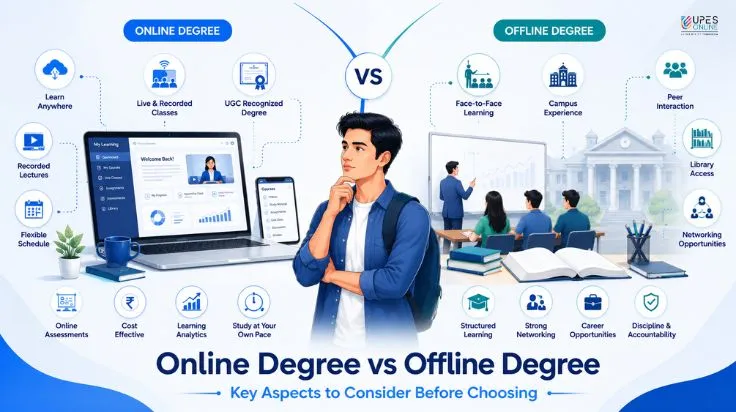
Online Degree vs Offline Degree: Key Aspects to Consider Before Choosing
Compare online degree vs offline degree based on flexibility, costs, career opportunities, recognition, & learning experience to choose the right program.
Read MoreJul 10, 2026 I 9 mins
Online B.Com Scope in 2026: Benefits, Careers, Salaries & Is It Worth It?
Explore online B.Com scope in 2026, including benefits, career options, salaries, industries, higher studies and whether an online B.Com degree is worth it.
Read MoreJul 31, 2026 I 11 mins
MBA for Working Professionals: Eligibility, Fees, Specializations & Career Scope
Explore a detailed guide on MBA for working professionals including eligibility, fees, online MBA options, top specializations, career scope & how to apply.
Read MoreAug 15, 2026 I 13 mins
Is Online MCA Worth It in 2026? Fees, Eligibility, Jobs & Colleges
Find out whether an Online MCA is worth it in 2026. Explore eligibility, fees, specializations, colleges, career scope, salaries and UGC validity.
Read MoreAug 29, 2026 I 11 mins
Online MBA for Engineers: Specializations & Career Scope
Find out if online MBA for engineers is a good choice; explore top specializations and career scope.
Read MoreSep 8, 2026 I 11 mins
Related Articles

Level Up Your Online MBA: Networking Tips for Success
Master virtual networking in an online mba program and learn types of business networking. Online MBA is the future.
Read Blog
Embracing the Digital Age: Why an MBA in Digital Business is a Must-Have
Staying ahead and at pace in this digital age makes an MBA in digital business an essential high education course.
Read Blog
Digital Marketing Interview Questions in 2026 (Covers All)
Clear your next digital marketing interview with essential questions asked in 2026. From SEO to social media, PR, branding, content & impress the hiring manager
Read Blog
Prompt Engineering Basics, Uses, Examples & Applications
Level up your AI game! Your guide to prompt engineering & creative AI outputs. Real life applications + + tips to get started.
Read BlogLevel Up Your Online MBA: Networking Tips for Success
Master virtual networking in an online mba program and learn types of business networking. Online MBA is the future.
Read BlogEmbracing the Digital Age: Why an MBA in Digital Business is a Must-Have
Staying ahead and at pace in this digital age makes an MBA in digital business an essential high education course.
Read BlogDigital Marketing Interview Questions in 2026 (Covers All)
Clear your next digital marketing interview with essential questions asked in 2026. From SEO to social media, PR, branding, content & impress the hiring manager
Read BlogPrompt Engineering Basics, Uses, Examples & Applications
Level up your AI game! Your guide to prompt engineering & creative AI outputs. Real life applications + + tips to get started.
Read Blog