
 Call Now
 Programs
  About
About 

How to Identify Online Fake Universities & Degree Scams
Online and distance learning education has progressed significantly in India in recent years. According to a recent report by AISHE, India now has over 43.9 lakh distance learners and 1.51 lakh online learners at the university level. While the progress allows working professionals and graduates to access flexible online degree courses at much lower costs, it also provides opportunities for scammers to take advantage of prospective students. As per UGC’s February 2026 fake university list, the central body identified 32 entities as fake universities across 12 states. If you are someone looking for an online degree program, it is essential to do an in-depth analysis and homework before applying for a program. In this article, we will discuss UGC’s fake university list along with how you can identify online degree scams.
Why Online Degree Scams Are a Serious Risk
Online degree scams in India are a serious issue, putting your hard-earned money at risk and causing potential career consequences. Many fraudulent entities lure professionals and students alike by offering online UG/PG degrees, backdated certificates, and other academic documents. Using a fake degree for job applications can have severe consequences in your professional career, as in most cases such a finding may result in immediate termination. In some cases, degree holders may even have to face legal consequences. Therefore, online degree scams not only have financial consequences; they can also cause issues with your professional life.
What is a Fake University?
A fake university is an entity that promises to offer an original higher education UG/PG degree without having proper recognition or authorization from governing bodies. However, if you are looking for an online professional program, not all recognized universities are entitled to do so. UGC-DEB regulates recognition and entitlement for online and ODL programs. Depending on the HEI category, universities must meet applicable UGC-DEB eligibility and program requirements before offering online degrees. As per the February 2026 UGC fake universities list data, it found 32 entities to be fake universities in India.
Fake University vs Unrecognized Online Course
While fake universities are those entities that offer degrees without UGC recognition, not all UGC-recognized universities are allowed to offer online courses. Verify that the HEI and exact program have the applicable UGC recognition/entitlement status for Online mode and the relevant academic session. Let’s understand the difference between the two from the following table:
|
Factor |
Fake university | Legitimate university with unapproved online program | Valid online program |
|---|---|---|---|
|
Institution status |
Not authorized to award degrees |
May be recognized as a university | Recognized/entitled institution |
|
Program approval |
Not valid | May not be entitled to that mode/program/session | Listed on UGC-DEB where applicable |
|
Student risk |
Very high | High | Lower, after full verification |
|
What to check |
UGC fake university list | UGC-DEB program listing | UGC/DEB listing and official university website |
How Can You Check Whether an Online University Is Genuine?
To verify an online degree in India, first confirm that the institution is legally recognized and check whether it appears on UGC's current fake-university list. For Online or ODL admission, separately verify the exact HEI, program, mode, and academic session on the UGC-DEB portal. Students enrolled in Online/ODL programs must also create a valid DEB-ID using their ABC-ID.
UGC Fake University List 2026: Where to Check
UGC's fake-university list changes over time as the Commission updates its records and takes action concerning unauthorized entities. As of February 2026, the official list contains 32 entries. Students should therefore check the live UGC page rather than rely only on older published lists. To protect yourself from online fraud, check the UGC list of fake universities on the official website.
Check the UGC Fake University List as of February 2026 - Here!
Note: UGC’s list of fake universities is time-sensitive, and the commission updates it based on new developments.
State Wise UGC Fake University List 2026
As of February 2026, the following is the list of UGC list of fake universities in India:
|
|
Number of fake universities | Name of fake university |
|---|---|---|
| Andhra Pradesh | 2 |
|
|
Arunachal Pradesh |
1 |
|
| Delhi | 12 |
|
|
Haryana |
1 |
|
|
Jharkhand |
1 |
|
|
Karnataka |
2 |
|
|
Kerala |
2 |
|
|
Maharashtra |
2 |
|
|
Puducherry |
2 |
|
|
Rajasthan |
1 |
|
|
Uttar Pradesh |
4 |
|
|
West Bengal |
2 |
|
Note: The list above reproduces UGC’s fake-university list as of February 2026. Because the list can change, always verify the live UGC page before making an admission decision.
Warning Signs of an Online Fake University & Degree Scams
Often, entities trying to sell you an unauthorized degree course or a fake degree certificate follow similar tactics such as promoting exceptional promises, backdated certificates, and not using professional communication channels. You should be vigilant and try to notice warning signs that may raise suspicions to shield yourself from being a victim of an online degree scam. The following are some of the key warning signs that you must look out for:
1. No official recognition: If the institution cannot be verified through UGC, or the exact online program cannot be verified through UGC-DEB for the relevant session, stop the admission process.
2. Too good to be true promises: Often, fake universities lure students with fake promises that sound too good to be true, such as guaranteed placements, education loans at very low interest rates, very high-salary packages, etc.
3. Pressure to pay upfront payments: Fake university operators often put pressure on victims to pay upfront tuition fees and do not offer a structured payment plan.
4. No authorized payment sources: Operators may ask students to make direct account transfers or ask for cash payments.
5. No verifiable campus: Fake university agents may struggle to offer information regarding a verifiable campus, academic faculty, or statutory disclosures.
6. Claims without proof: Fraudulent universities may make bold claims regarding accreditation, status, placement records, and salaries without offering proof.
7. Incorrect logos: Fake universities may use wrong logos, non-trademarked images, and false iconography.
8. Claims of offering backdated certificates or degrees: Agents working for a fake university may offer backdated certificates or offer degrees in weeks or months.
9. Non-business emails or inconsistent website: Legitimate universities and their stakeholders use professional email addresses and phone numbers for all kinds of correspondence.
10. No clear refund or grievance redressal policy: A fake university is not likely to have a refund policy or a structured framework to address student concerns.
Can Every Degree Be Offered Online in India?
No. UGC regulations do not permit every discipline to be offered through Online or Open and Distance Learning (ODL) modes. For example, certain technical and professional programs, such as B.Tech and M.Tech, are generally not permitted through online mode. On the other hand, business programs such as online BBA and MBA courses can be offered by eligible higher education institutions with the required UGC-DEB recognition or approval. Students should therefore verify both the university’s recognition status and whether the specific program is permitted in the intended mode of learning.
What is a DEB-ID and Why Does It Matter?
DEB-ID is a mandatory learner ID for students seeking admission to ODL or Online programs in India. It is created through the UGC-DEB portal using the learner's ABC-ID. UGC-DEB states that students cannot enroll in an ODL/Online program without a valid DEB-ID. The system is intended to help ensure that learners take admission in recognized/entitled HEIs and approved programs.
How to Verify an Online University Before Taking Admission
If you are planning to join an online program, you must first verify the legitimacy of the university you are applying to. You do so in a few simple steps:
Step 1: Check UGC Recognition of the University
Go to the official UGC website and check the list of UGC recognized universities in the country. Here, locate the university you are applying for to verify its recognition status.
Step 2: Check UGC-DEB Entitlement for the Exact Online Program
For online programs, institutes are required to obtain necessary UGC-DEB approvals. Therefore, check whether the said university is entitled to offer online courses or not.
|
What to match |
Example |
|---|---|
|
Institution name |
Exact legal university name |
|
Program name |
MBA, BBA, MCA, etc. |
|
Mode |
Online, ODL, or campus |
|
Academic session |
Current admission session |
|
Entitlement status |
Listed/entitled for the relevant period |
Step 3: Verify Professional-Regulator Requirements Where Needed
Some programs may require approval, recommendation, or compliance with another statutory or professional regulator in addition to UGC-DEB. For example, AICTE-related requirements may apply to certain programs and institutions.
Step 4: Verify the Right Application Channel
Apply through the university's verified official admission channel. If contacted by a counsellor or representative, independently verify their identity using contact information published on the university's official website rather than relying solely on the phone number, email, or WhatsApp account that contacted you.
Step 5: Save Evidence Before Paying Fees
Before making the payment for the course, save all the documents and evidence in advance. You should also keep the payment records and receipts with you.
How to Check Whether a Degree Certificate is Genuine
A degree certificate that looks authentic may still be fraudulent, while formatting differences alone do not prove that a certificate is fake. Institutional verification is more reliable than visual inspection. Consider the following while verifying a certificate's authenticity:
1. Verify that the awarding institution was legally authorized for the relevant period.
2. For an Online/ODL degree, verify the program/mode/session where applicable.
3. Confirm the learner's enrollment/registration details through the university's official verification process where available.
4. Verify digital academic records through official systems such as DigiLocker/NAD where applicable.
5. Contact the registrar/controller of examinations through contact details independently obtained from the official university website.
6. Compare the certificate details with official university records rather than relying only on logos, seals, or signatures.
7. If verification is for employment or another formal purpose, use the institution's official degree-verification process.
Common Online Degree Scam Tactics You Should Know
Most fake universities use common scam tactics to lure and pressurize students to make payments. Some of these common tactics include:
- Impersonation websites with similar domains
- Fake UGC and AICTE logo usage
- Admission agents using unofficial WhatsApp numbers
- Direct degree or backdated certificate offers
- False placement guarantees
- Fake rankings, accreditation badges, and review pages
- Deepfake faculty videos or fabricated testimonials
What to Do when you Suspect an Online Degree Scam
Prompt reporting may help authorities and financial institutions investigate the fraud and, in some financial-cyber-fraud cases, may improve the possibility of stopping or tracing funds. Recovery is not guaranteed.
In case of potential fraud, you should:
1. Stop further payments.
2. Save messages, receipts, advertisements, URLs, and offer letters.
3. Contact the university through its verified official channel.
4. Check UGC and UGC-DEB records.
5. Report cyber-enabled fraud through the appropriate official cybercrime reporting channel and local police, where necessary.
6. Raise a complaint with the relevant education authority or regulator.
7. Online University Verification Checklist Before Admission
Before applying for an online program, you should have a quick checklist with you. An ideal checklist may include:
|
Check |
Verify |
|---|---|
|
Institution |
Exact legal university name |
|
UGC status |
Institution's official status |
|
Fake-university list |
Not currently listed |
|
Program |
Exact program name |
|
Mode |
Online vs ODL |
|
Session |
Current admission session |
|
DEB-ID |
Created through ABC-ID |
|
Additional regulator |
If applicable |
|
Domain |
Official university website |
|
Payment |
Verified institutional channel |
|
Refund policy |
Available in writing |
|
Admission evidence |
Saved before payment |
Conclusion
Avoiding an online degree scam requires more than checking whether a university name looks familiar. Verify the institution through UGC, check the exact Online/ODL program, mode, and academic session through UGC-DEB, confirm whether the discipline is permitted, create the required DEB-ID, and apply only through verified institutional channels. Because regulatory lists and program status can change, use live official sources at the time of admission rather than relying only on older articles, advertisements, or screenshots.
FAQs
How to check if a university is real or fake?
Verifying the recognition status of a university is easy; you can go to the official UGC website and check the list of recognized universities in India. On the UGC website, click on the UGC-DEB online and ODL program list and verify the particular institute.
Which universities are blacklisted by the UGC for 2026?
UGC identifies universities that are not authorized to offer degrees from time to time. As per the latest list, which was released in February 2026, the commission identified 32 entities as fake universities.
How to detect a fake degree?
To detect a fake degree, you should first verify the recognition status of the university. You can also check the degree for inconsistencies such as enrollment numbers, signatures, and more.
What is considered a fake degree?
A fake degree is an academic document that has either been forged or has been issued by an entity that doesn’t have proper authorization to do so. Only those universities that are recognized by UGC can issue a professional degree in India. Furthermore, to issue online degrees, UGC-DEB entitlement is necessary.
What is the punishment for a fake degree certificate in India?
Using a forged or fraudulently obtained degree can lead to serious employment, disciplinary, and legal consequences depending on the circumstances, applicable law, and whether the person knowingly created, obtained, or used a false document. Consequences are case-specific, so a single prison term or penalty should not be stated as applying to every fake-degree case.
UPES Online Admission Enquiry
Recommended Courses







Latest Blogs
What Are the Best Online MBA Programs at UPES Online?
Choose the best online MBA programs at UPES Online. Learn about specializations, career scope, & why professionals choose UPES for flexible learning.
Read MoreOct 15, 2025 I 6 mins
General MBA vs Specialized MBA: How to Choose Your Path in 2026?
General MBA vs specialized MBA compared on metrics like scope, ROI, salary & career growth in India. Understand the path & choose wisely.
Read MoreMay 3, 2026 I 8 mins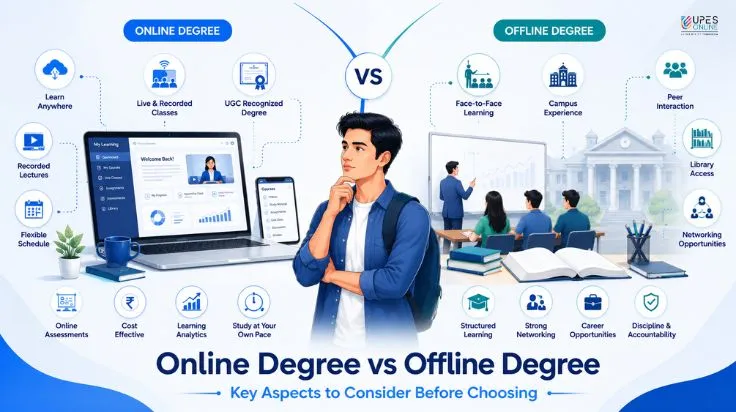
Online Degree vs Offline Degree: Key Aspects to Consider Before Choosing
Compare online degree vs offline degree based on flexibility, costs, career opportunities, recognition, & learning experience to choose the right program.
Read MoreJul 10, 2026 I 9 mins
Online B.Com Scope in 2026: Benefits, Careers, Salaries & Is It Worth It?
Explore online B.Com scope in 2026, including benefits, career options, salaries, industries, higher studies and whether an online B.Com degree is worth it.
Read MoreJul 31, 2026 I 11 mins
MBA for Working Professionals: Eligibility, Fees, Specializations & Career Scope
Explore a detailed guide on MBA for working professionals including eligibility, fees, online MBA options, top specializations, career scope & how to apply.
Read MoreAug 15, 2026 I 13 mins
Is Online MCA Worth It in 2026? Fees, Eligibility, Jobs & Colleges
Find out whether an Online MCA is worth it in 2026. Explore eligibility, fees, specializations, colleges, career scope, salaries and UGC validity.
Read MoreAug 29, 2026 I 11 mins
Online MBA for Engineers: Specializations & Career Scope
Find out if online MBA for engineers is a good choice; explore top specializations and career scope.
Read MoreSep 8, 2026 I 11 mins
Related Articles
Online MBA for Engineers: Specializations & Career Scope
Find out if online MBA for engineers is a good choice; explore top specializations and career scope.
Read Blog
Top 10 Online MBA Programs in India 2026: Fees & Specializations
Compare 10 Online MBA programs in India for 2026 by UGC-DEB status, fees, NAAC accreditation, specializations, learning format, career support.
Read BlogMBA for Working Professionals: Eligibility, Fees, Specializations & Career Scope
Explore a detailed guide on MBA for working professionals including eligibility, fees, online MBA options, top specializations, career scope & how to apply.
Read BlogIs Online MCA Worth It in 2026? Fees, Eligibility, Jobs & Colleges
Find out whether an Online MCA is worth it in 2026. Explore eligibility, fees, specializations, colleges, career scope, salaries and UGC validity.
Read BlogOnline MBA for Engineers: Specializations & Career Scope
Find out if online MBA for engineers is a good choice; explore top specializations and career scope.
Read BlogTop 10 Online MBA Programs in India 2026: Fees & Specializations
Compare 10 Online MBA programs in India for 2026 by UGC-DEB status, fees, NAAC accreditation, specializations, learning format, career support.
Read BlogMBA for Working Professionals: Eligibility, Fees, Specializations & Career Scope
Explore a detailed guide on MBA for working professionals including eligibility, fees, online MBA options, top specializations, career scope & how to apply.
Read BlogIs Online MCA Worth It in 2026? Fees, Eligibility, Jobs & Colleges
Find out whether an Online MCA is worth it in 2026. Explore eligibility, fees, specializations, colleges, career scope, salaries and UGC validity.
Read Blog