 Call Now
 Programs
  About
About 

How to Become a Project Manager with Online MBA in India: Detailed Guide

Project Management is one of the most popular job profiles in India, driven by growing demand for professionals who can manage complex business projects and achieve business goals. According to the 2025 Global Project Management Talent Gap report published by the Project Management Institute, demand for project professionals worldwide could reach up to 29.8 million by 2035. Furthermore, the report also highlights that as of 2025, there were already almost 40 million project professionals working globally across diverse industries, highlighting the growing scale of the profession and potential increase in the demand for Project Managers. These trends explain why more working professionals are now looking to transition into Project Manager roles. In this article, we will explain how to become a project manager, the skills needed, and a complete roadmap to do so.
How to Become a Project Manager in India?
There is no single higher education degree in India to become a project manager. A common pathway to become a project manager is to first complete a bachelor's degree and build skills in planning, budgeting, communication, risk, and stakeholder management, gain practical project experience, learn relevant project-management tools, and progress through roles such as Project Coordinator or Project Analyst. Furthermore, an MBA or a professional program also helps gain key industry-relevant skills.
How to Become a Project Manager with an Online MBA?
The road to becoming a project manager starts as early as your graduation, as it enlists foundational skills such as professional communication, reporting, collaboration, and teamwork and goes all the way to your postgraduate education. If you are an aspiring project manager and a working professional, the following section will explain a clear career plan on how to become a project manager with an online MBA program:
1. Earn a Relevant Bachelor’s Degree: Many project-management professionals begin with a bachelor's degree in areas such as business, engineering, technology, or another field related to the industry in which they work. However, educational requirements vary by employer and role, and project-management careers are not restricted to one undergraduate discipline.
2. Build Soft Project Management Skills: Throughout your bachelor’s degree, you can work on building crucial project management skills such as professional communication, critical thinking, business planning, and reporting.
3. Pursue a Relevant Online MBA: After completing your bachelor's degree, you can pursue an MBA in Project Management or in a relevant stream. While not mandatory to apply for project management jobs, an MBA degree significantly strengthens your chances of securing high-paying, high-responsibility roles. If you are a working professional aiming to upskill your profile to get a project management job, you can pursue an online MBA in related fields.
4. Gain Practical Knowledge: During the MBA program, you can work on gaining hands-on practical knowledge and experience with internships, projects, etc. As a working professional, you can also apply your classroom learnings to live projects to get real-time learning opportunities.
5. Develop Technical Project Management Skills: Invest time in learning project management analytics, industry-used software systems, and other key technical skills to become job-ready.
6. Consider a Project Management Certificate: To further advance your career prospects as a project manager, you can also consider pursuing a project management certification program to gain technical skills.
7. Apply for Project Management Jobs: Finally, apply for jobs in project management such as Project Coordinator, Project Administrator, Project Analyst, Assistant Project Manager. You can apply through online job portals and in-person interview drives.
What does a Project Manager Do?
Project Manager is a crucial bridge between teams working on a particular project and business leadership. The main responsibility of a Project Manager is to oversee and manage the entire lifecycle of the project from start to finish. The Project Manager looks after deadlines, planning, resource allocation, and timely reporting of the project's progress. The following are some of the key responsibilities of a project manager:
| Responsiblities | What it means |
|---|---|
|
Scope |
Define what the project will deliver |
|
Schedule |
Plan milestones and deadlines |
|
Budget |
Track project expenditure |
|
Resources |
Coordinate people and tools |
|
Risk |
Identify and respond to threats |
|
Stakeholders |
Keep decision-makers informed |
|
Quality |
Ensure agreed standards are met |
Also check: Top 10 Online MBA Programs in India 2026
What Skills Do You Need to Become a Project Manager?
To become a successful project manager, you must possess several soft, professional, and technical skills. The following are some of the key skills required to become a project manager in India:
Professional and Soft Skills Needed to Become a Project Manager:
- Communication
- Teamwork
- Collaboration
- Problem solving
- Critical thinking
- Conflict resolution
- Leadership
- Adaptability
- Time management
- Project planning
- Project road mapping
- Task management
Technical Skills Needed to Become a Project Manager:
- Project management tools (Jira, Microsoft Project, Asana, Trello, Monday.com, Smartsheet)
- Gantt charts
- Kanban boards
- Team management
- Workload management
- Cost management
- Project portfolio management
How Does an Online MBA Help You Become a Project Manager?
An online MBA helps graduates and working professionals alike transition into Project Management roles by enlisting key business skills. Online MBA programs not only include academic learning but also offer comprehensive upskilling opportunities, which provide an in-depth understanding of how businesses operate and how managers create workflows for smooth operations of projects. The following points explore how an online MBA can help you become a project manager by enlisting skills such as:
1. Business Strategy: An online MBA explores tactical execution of tasks instead of applying traditional methods of business operations. Students learn to align business interests and goals with day-to-day business activities.
2. Leadership: Online MBA programs allow students to learn leadership skills through project work, internship programs, and exploring subjects like strategic management. Students learn to manage teams, resolve disruptions, manage resources, and engage in strategic planning, budgeting, and cross-functional collaboration.
3. Financial Management: Understanding budgets, costs, financial trade-offs, and business cases can help project managers make better-informed resource decisions.
4. Operations Management: Exposure to process design, capacity, resource allocation, and continuous improvement can help project professionals understand how projects interact with day-to-day business operations.
5. Business Analytics: Analytics coursework can help learners interpret project and business data, track KPIs, and use evidence to support decisions.
6. Decision-Making: Based on in-depth analysis of project metrics and overall performance, students in the online MBA learn to make informed decisions that are in the best interest of the overall business.
7. Risk Management: Project Managers learn to assess forthcoming risks and hurdles, and prepare plans to mitigate the adverse effects of the same.
Can You Become a Project Manager Without an MBA?
Yes, you can become a project manager without an MBA, as it is not a compulsory prerequisite. However, an MBA degree explores key concepts and skills that are required to become a project manager and is generally considered to give you a good head start to a promising career.
Online MBA vs Project Management Certification: What's the Difference?
Many working professionals often wonder whether they should pursue a full-time project management course or complete a specialized project management certification program. While both could be excellent options based on your experience and skill levels, they differ in terms of depth of the program and their scopes. The following are some of the key differences between the two:
|
Online MBA |
Project Management Certification |
|---|---|
|
Broader management education |
Focused project-management credential |
|
Covers business functions |
Covers PM methodologies/practices |
|
Develops business acumen |
Validates PM knowledge/competence |
|
Usually longer program |
Generally shorter |
|
Useful for broader management careers |
More specialized |
|
Can support career progression |
Can strengthen PM credentials |
What Certifications Can Help You Become a Project Manager?
Various industry-recognized certifications can help you upskill your profile to become a project manager. The following are some of the top choices for working professionals:
1. Professional Certificate in Project Management: A professional certificate in Project Management is generally a 3-to-6-month program that offers technical skills in project management, which explores both basic and advanced project management skills.
2. Certified Associate in Project Management (CAPM): CAPM can be considered by candidates who want a foundational PMI credential but do not yet meet PMP's project-leadership experience requirements. PMI currently requires a secondary qualification and at least 23 hours of project-management education before the CAPM exam. Applicants should verify the latest eligibility requirements directly with PMI.
3. Project Management Professional (PMP) Certification: PMP is an advanced PMI certification intended for professionals with substantial project leadership experience. Eligibility depends on educational background and project experience, so applicants should check PMI’s latest requirements before applying.
Industries Hiring Project Managers in India
Project Manager jobs in India are widely available across sectors. Some of the key industries that hire project managers include:
- IT and technology
- Construction
- Consulting
- BFSI
- Healthcare
- Manufacturing
- E-commerce
- Telecommunications
- Energy
- Education
- Media and advertising
Project Manager Salary Growth in India
Project Manager salary in India may begin at around INR 7 LPA and go up to INR 25 LPA and beyond based on your experience and skill set. The following are potential salary growth prospects for Project Managers in India based on experience and experience levels.
|
Experience level |
Years of Experience | Indicative Salary in India |
|---|---|---|
|
Early Career |
1 to 3 | INR 7 to INR 12 LPA |
|
Executive |
4 to 6 | INR 9 to INR 15 LPA |
|
Mid-Senior Level |
7 to 9 | INR 12 to INR 18 LPA |
|
Senior Level |
10 to 14 | INR 16 to INR 20 LPA |
|
Late Career/Leadership Role |
15+ | INR 18.5 to INR 25 LPA |
Note: Salary figures may vary depending on organizations, industries, and overall skill set. The above-mentioned salaries are sourced from Glassdoor.com.
Is Project Management a Good Career in 2026?
In 2026, the project management skill gap is increasingly becoming a global workforce issue, with PMI reporting the need for over 29.8 million project professionals by 2035. Furthermore, the World Economic Forum's Future of Jobs Report 2025 lists Project Managers among job categories expected to drive the largest net job growth between 2025 and 2030. Growing infrastructure and technological investments make India an ideal place for Project Management jobs offering diverse career opportunities across industries, making project management a good career to have in 2026.
Is an Online MBA Worth It for Aspiring Project Managers?
Yes, an online MBA is worth pursuing for aspiring project managers, especially working professionals. An online MBA program allows working professionals to gain crucial technical and professional skills to switch careers into project management roles. Online MBA programs are especially designed to cater to the needs of working professionals and allow them to continue their jobs and offer flexibility to learn at their own pace. Furthermore, professionals can also apply their course learnings to their day-to-day activities and take up more managerial roles in their current roles. Therefore, an online MBA is worth it for aspiring project managers not just as a learning opportunity, but also as a crucial career decision.
Roadmap to Become Project Manager in India
The step-by-step roadmap to become a project manager with an online MBA in India looks like the following:
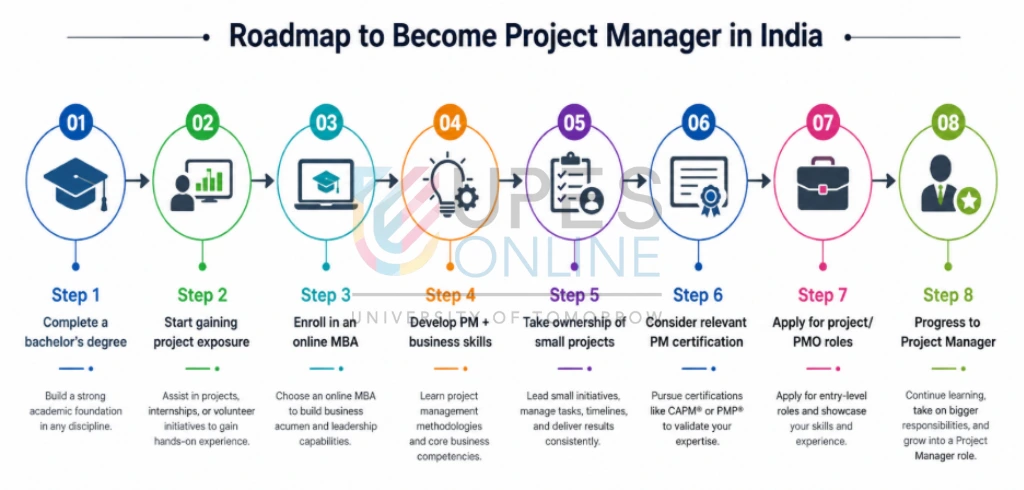
Project Manager remains one of the most popular job profiles in India, and with growing industries and investments, the demand for the role is expected to increase over time. Working professionals who are aspiring to take up project management roles can pursue online MBA to upskill their profiles and transition to diverse roles. Professionals are required to have analytical, communication, and technical skills to become a project manager.
FAQs
What qualifications do you need to be a project manager?
The qualifications to become a project manager include a mix of academic and skill-based qualifications. Typically, you are required to have a minimum of graduate-level education and skills such as professional communication, analytical skills, PM software skills, and more to be qualified as project managers.
Which is better, MBA or PMP Certificate?
Neither an MBA nor a PMP Certification is better than the other. MBA programs are comprehensive degree programs focused on a detailed understanding of project management skills. On the other hand, the PMP certification course is a specialized program focused on project management skill development for professionals.
Can I become a Project Manager without experience?
While it is possible to become a Project Manager without having prior experience, to secure a mid-senior or associate-level position, you are generally required to have up to 3 to 5 years of experience.
How do I start my career as a project manager?
To start a career as a project manager, you are first required to complete your formal education in relevant fields, gain specialized skills, and build an effective portfolio with projects and industry internships. You may even pursue a professional certification course to further advance your career prospects.
Are project managers in demand?
Yes, project managers are in demand across diverse industries as businesses across industries expand and take on new projects. As per a report by PMI, by 2035, the global workforce will require 29.8 million more project professionals, signaling growing demand for professionals.
UPES Online Admission Enquiry
Recommended Courses







Latest Blogs
What Are the Best Online MBA Programs at UPES Online?
Choose the best online MBA programs at UPES Online. Learn about specializations, career scope, & why professionals choose UPES for flexible learning.
Read MoreOct 15, 2025 I 6 mins
General MBA vs Specialized MBA: How to Choose Your Path in 2026?
General MBA vs specialized MBA compared on metrics like scope, ROI, salary & career growth in India. Understand the path & choose wisely.
Read MoreMay 3, 2026 I 8 mins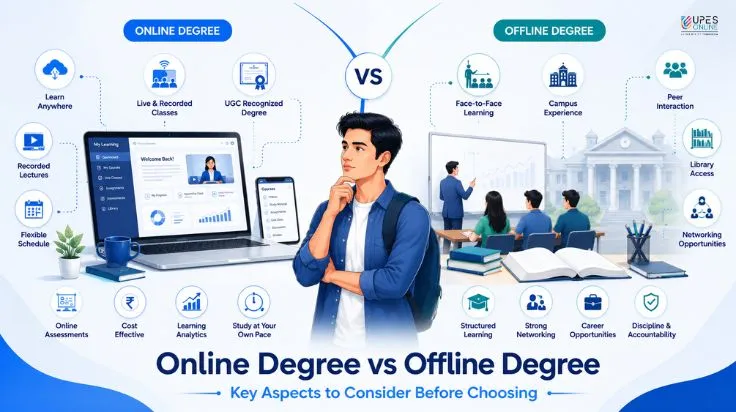
Online Degree vs Offline Degree: Key Aspects to Consider Before Choosing
Compare online degree vs offline degree based on flexibility, costs, career opportunities, recognition, & learning experience to choose the right program.
Read MoreJul 10, 2026 I 9 mins
Online B.Com Scope in 2026: Benefits, Careers, Salaries & Is It Worth It?
Explore online B.Com scope in 2026, including benefits, career options, salaries, industries, higher studies and whether an online B.Com degree is worth it.
Read MoreJul 31, 2026 I 11 mins
MBA for Working Professionals: Eligibility, Fees, Specializations & Career Scope
Explore a detailed guide on MBA for working professionals including eligibility, fees, online MBA options, top specializations, career scope & how to apply.
Read MoreAug 15, 2026 I 13 mins
Is Online MCA Worth It in 2026? Fees, Eligibility, Jobs & Colleges
Find out whether an Online MCA is worth it in 2026. Explore eligibility, fees, specializations, colleges, career scope, salaries and UGC validity.
Read MoreAug 29, 2026 I 11 mins
Online MBA for Engineers: Specializations & Career Scope
Find out if online MBA for engineers is a good choice; explore top specializations and career scope.
Read MoreSep 8, 2026 I 11 mins
Related Articles
Online MBA for Engineers: Specializations & Career Scope
Find out if online MBA for engineers is a good choice; explore top specializations and career scope.
Read Blog
Top 10 Online MBA Programs in India 2026: Fees & Specializations
Compare 10 Online MBA programs in India for 2026 by UGC-DEB status, fees, NAAC accreditation, specializations, learning format, career support.
Read Blog
How to Identify Online Fake Universities & Degree Scams
Check the UGC fake university list 2026 and learn how to verify an online university, course entitlement, and whether a degree certificate is original or fake.
Read Blog
Product Analyst vs Data Analyst: Skills, Responsibilities, Salary
Compare product analyst with data analyst roles, skills, tools, responsibilities, salaries & career growth in India to choose the right data career.
Read Blog
Highest Paying Jobs After an Online MBA in India
Explore high-paying jobs after an online MBA in India, salary ranges, MBA specializations, skills, and industries for management careers in 2026.
Read BlogOnline MBA for Engineers: Specializations & Career Scope
Find out if online MBA for engineers is a good choice; explore top specializations and career scope.
Read BlogTop 10 Online MBA Programs in India 2026: Fees & Specializations
Compare 10 Online MBA programs in India for 2026 by UGC-DEB status, fees, NAAC accreditation, specializations, learning format, career support.
Read BlogHow to Identify Online Fake Universities & Degree Scams
Check the UGC fake university list 2026 and learn how to verify an online university, course entitlement, and whether a degree certificate is original or fake.
Read BlogProduct Analyst vs Data Analyst: Skills, Responsibilities, Salary
Compare product analyst with data analyst roles, skills, tools, responsibilities, salaries & career growth in India to choose the right data career.
Read BlogHighest Paying Jobs After an Online MBA in India
Explore high-paying jobs after an online MBA in India, salary ranges, MBA specializations, skills, and industries for management careers in 2026.
Read BlogOnline MBA for Engineers: Specializations & Career Scope
Find out if online MBA for engineers is a good choice; explore top specializations and career scope.
Read Blog