
 Call Now
 Programs
  About
About 

Operations Management vs Supply Chain Management
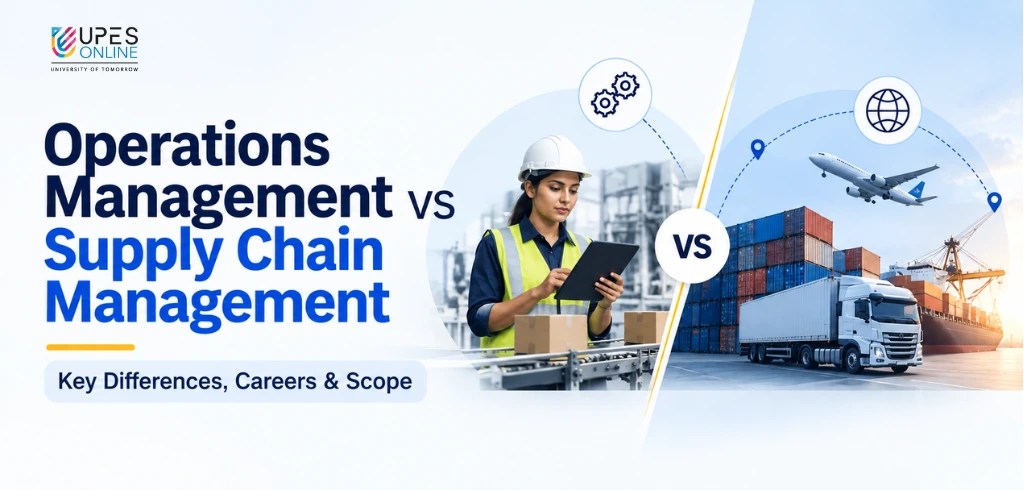
Operations Management and Supply Chain Management are two closely connected business functions. However, they are fundamentally different from each other in different areas of an organization. Operations Management primarily deals with improving internal processes, productivity, quality, and resource utilization, while Supply Chain Management manages the broader flow of materials, information, and products from suppliers to customers. Understanding the difference between Operations Management vs Supply Chain Management can help students and professionals choose the right career path or the right specializations, such as an MBA in Operations Management or Logistics & Supply Chain Management.
What is Operations Management?
Operations Management is the management discipline concerned with designing, running, and improving the processes through which an organization produces goods or delivers services. It covers areas such as process design, capacity, quality, resource allocation, production or service delivery, inventory, and continuous improvement. Effective operations management can help organizations improve efficiency, reliability, cost control, and responsiveness.
What do Operations Managers Do?
In their day-to-day activities, Operations Managers work on process optimizations, overseeing supply chains, quality control, and allocating resources efficiently. Operations Managers are largely responsible for ensuring the smooth running of business functions while ensuring cost-effective and efficient measures.
What is Supply Chain Management?
Supply Chain Management is a unit of business operations that focuses on end-to-end networks and optimizes the flow of goods, information, and resources. Supply Chain Management ensures the efficient handling of the flow of goods, information, and money across every step from suppliers to stores. The main components of Supply Chain Management include planning, sourcing, manufacturing, delivery, and returns. Supply Chain Management helps businesses with lowering costs by managing waste, extra storage, and shipping delays, improving quality, and building trust with timely delivery and stock optimization.
What do Supply Chain Managers Do?
Supply Chain Managers are responsible for overseeing the entire supply chain lifecycle for businesses. They are responsible for ensuring efficient delivery, minimum costs, and optimized inventories.
What is the Difference Between Operations Management and Supply Chain Management?
Operations Management focuses primarily on designing, running, and improving the processes that produce and deliver goods or services within an organization. Supply Chain Management takes a broader network view, coordinating activities such as planning, sourcing, procurement, logistics, inventory, and distribution across suppliers, organizations, and customers. The two fields overlap significantly, especially in planning, inventory, production, and logistics.
Operations Management vs Supply Chain Management: Quick Comparison
While Operations Management focuses on internal processes to convert resources such as raw materials into usable goods, supply chain management ensures that the entire product lifecycle goes through efficiently without disruptions. The following table provides a quick comparison of both:
|
Parameter |
Operations Management | Supply Chain Management |
|---|---|---|
|
Primary focus |
Internal business operations | End-to-end supply network |
|
Main objective |
Improve efficiency and productivity | Optimize flow of goods, information, and resources |
|
Scope |
Processes within an organization | Suppliers to customers |
|
Key activities |
Production, quality, capacity, process improvement | Procurement, logistics, inventory, distribution |
|
Typical roles |
Operations Manager, Production Manager, Process Manager | Supply Chain Manager, Logistics Manager, Procurement Manager |
|
Key skills |
Process optimization, quality management, analytics | Logistics, procurement, forecasting, inventory management |
|
Common industries |
Manufacturing, healthcare, IT, services | Manufacturing, retail, e-commerce, logistics |
|
Areas of overlap |
Planning, inventory, procurement, logistics, analytics | Planning, inventory, production coordination, logistics, analytics |
Operations Management vs Supply Chain Management: Key Difference
Operations Management focuses on how a business runs its internal processes, whereas Supply Chain Management focuses on how goods, information, and resources move across the wider supply network. Let’s understand the key differences between the two here:
Difference in Scope
The key difference between Operations Management and Supply Chain Management is their scope. Operations Management focuses on improving internal processes that transform inputs into goods and services. At the same time, Supply Chain Management looks at the broader network of suppliers, partners, logistics providers, and distribution channels that move products from source to customer.
Difference in Responsibilities
The key responsibilities for Operational Management include:
- Production planning: Schedule manufacturing runs and meet daily goals.
- Quality control: Inspect goods and maintain high standards.
- Process improvement: Cut waste and boost plant efficiency.
- Resource management: Look after factory workers and equipment.
Key responsibilities for Supply Chain Management include:
- Procurement: Source and buy raw materials from outside vendors.
- Logistics and transportation: Move goods between distant locations.
- Warehousing: Store inventory safely until needed.
- Vendor management: Negotiate contracts and build supplier partnerships.
Difference in Objective
The core objective of Operations Management is to maintain internal control and improve processes to create value efficiently. Supply Chain Management, on the other hand, focuses on external collaboration and managing the end-to-end flow of materials, information, and products from suppliers to customers.
|
Objectives of Operations Management |
Objectives of Supply Chain Management |
|---|---|
|
Internal Efficiency |
Network Integration |
|
Resource Transformation |
Seamless Flow |
|
Quality and Control |
Risk and Cost Mitigation |
Difference in Skills
Some of the key skills required for Operations Management include process optimization, quality assurance, and resource allocation. On the other hand, Supply Chain Management requires skills such as vendor negotiation, demand forecasting, logistics coordination, and risk mitigation.
Difference in Tools & Technologies Used
Both modern Operations and Supply Chain Management use different software tools and technologies to ensure efficient production. The following are some of the key tools used for both:
|
Tools/Tech used in Operations Management |
Tools/Tech used in Supply Chain Management |
|---|---|
|
Six Sigma & Lean |
Warehouse Management Systems (WMS) |
|
Manufacturing Execution Systems |
Demand Forecasting Software |
|
ERP Production Modules |
Transportation Management Systems |
Also check: MBA Digital Marketing vs Marketing
How Are Operations Management and Supply Chain Management Related?
Operations Management and Supply Chain Management are closely connected business functions that work together to transform raw materials into finished products and deliver them to customers. Operations Management focuses primarily on internal production and business processes, including managing people, resources, quality, and efficiency within an organization. SCM takes a broader, outward-looking approach by managing the network of suppliers, transportation providers, distributors, and delivery channels involved in moving materials and products from source to customer.
Operations Management vs Supply Chain Management: Skills Required
To succeed in Operations and Supply Chain Management careers, managers are required to possess several technical and soft skills. Both OM and SCM closely work in ensuing smooth business production and timely delivery to stores. The following are some of the key skills for both fields.
Skills for Operations Management
The following are the key skills required for Operations Management:
- Financial Management: Ensuring cost-effective operations by reading reports, tracking budgets, and forecasting costs.
- Process Optimization: Using methods such as Lean or Six Sigma to avoid bottlenecks and operational disruptions.
- Data Analysis: Identifying trends and interpreting metrics to make informed business decisions.
- Supply Chain & Logistics: Ensuring timely delivery through inventory optimization and smooth vendor contracts.
- Digital Tools and Software: Knowledge of software and tools such as Manufacturing Execution Systems and ERP Production Modules
- Planning and Prioritization: Prioritizing key tasks and planning as per inventory and market trends.
Skills for Supply Chain Management
Key skills required for Supply Chain Management include:
- Data Analysis & Visualization: Excel, SQL, Tableau, etc.
- Software Proficiency: Enterprise Resource Planning (ERP), Warehouse Management Systems (WMS), Demand Forecasting Software
- Logistics & Transportation: Warehouse operations, distribution, managing freight and distribution costs.
- Demand Planning & Inventory: Predicting consumer needs and optimizing inventories accordingly.
- Procurement & Sourcing: Managing raw materials and maintaining relationships with suppliers.
- Risk Management: Identifying potential disruptions and bottlenecks.
Operations Management vs Supply Chain Management: Career Opportunities
To explore career opportunities in these domains, students can pursue professional courses such as an MBA in Operations Management or an MBA in Logistics & Supply Chain Management. Some of the top careers include Operations Manager, Logistics Manager, and Procurement Manager.
Career Opportunities in Operations Management
Operations-focused education can support career paths across process improvement, production, service operations, quality, inventory, and operational leadership. The roles available to an individual depend on prior experience, industry, skills, and employer requirements.
|
Role |
Indicative Salary Range |
|---|---|
|
Operations Manager |
INR 10.8 to 11.9 LPA |
|
Inventory Manager |
INR 5.3 to 5.9 LPA |
|
Quality Assurance Manager |
INR 16.4 to 18.1 LPA |
|
Production Supervisor |
INR 3.4 to 3.7 LPA |
|
Plant Manager |
INR 16.8 to 18.6 LPA |
|
Warehouse Manager |
INR 6.8 to 7.5 LPA |
Note: Salary figures may vary based on several factors, including experience, role, responsibilities, and other factors. The above-mentioned numbers are sourced from AmbitionBox data.
Career Opportunities in Supply Chain Management
Supply Chain Management graduates work in diverse roles across industries. Some of the top roles include:
|
Role |
Indicative Salary Range |
|---|---|
|
Supply Chain Manager |
INR 14.6 to 16.1 LPA |
|
Logistics Manager |
INR 10.2 to 11.3 LPA |
|
Purchasing Manager |
INR 10.4 to 11.5 LPA |
|
Transportation Manager |
INR 6.9 to 7.6 LPA |
|
Procurement Manager |
INR 15.4 to 17.9 LPA |
|
Materials Manager |
INR 6.4 to 7.1 LPA |
Note: Salary figures may vary based on several factors, including experience, role, responsibilities, and other factors. The above-mentioned numbers are sourced from AmbitionBox data.
Operations Management vs Supply Chain Management: Which Career Is Right for You?
Deciding between Operations Management and Supply Chain Management for higher studies or careers can be a challenging choice. While both pathways offer promising prospects, you can base the decision on the following factors:
|
If you enjoy... |
Consider |
|---|---|
|
Improving internal processes |
Operations Management |
|
Production and quality |
Operations Management |
|
Managing teams and resources |
Operations Management |
|
Procurement and sourcing |
Supply Chain Management |
|
Logistics and transportation |
Supply Chain Management |
|
Inventory and demand planning |
Supply Chain Management |
|
|
Supply Chain Management |
|
End-to-end product movement |
Supply Chain Management |
What Courses Can You Pursue in Operations and Supply Chain Management?
If you are planning a career in operations and supply chain management, you can pursue several PG degrees and professional certification courses. A degree course helps students gain in-depth understanding of core management concepts and practical and industry-focused learning of different Operations and Supply Chain Management business units. The following are some of the most popular courses you can pursue:
MBA in Operations Management
MBA in Operations Management is a 2-year postgraduate program that focuses on preparing graduates with dynamic skills such as process optimization, data analysis, and industry-relevant tools and technologies. If you are a working professional, you can pursue an online MBA in Operations Management which allows you to continue your professional commitments while also earning a full-time degree program.
MBA in Logistics & Supply Chain Management
MBA in Logistics & Supply Chain Management is a 2-year postgraduate program focused on the concepts of design, optimization, and management of global goods, services, and information networks. Some of the key topics that are included in the MBA in Logistics & Supply Chain Management curriculum include strategic supply chain management, warehouse & inventory management, and procurement & sourcing.
Certification Courses
If you are looking to upskill your professional and technical operational and supply chain management skills, you can pursue several professional certification courses. Certification such as:
1. PG Certification in Operations Management: Focused on offering industry-ready skills in fields such as Operations Management, Lean Six Sigma methods, operational analytics, and data visualization, PG Certification Program in Operations Management is a 10-month program suitable for professionals working in Operations Management.
2. PG Certification in Logistics and Supply Chain Management: The PG Certification Program in Logistics and Supply Chain Management is a 10-month professional certification program that offers skills in Planning for Logistics, Supply Chain Modeling & Design, Business Policy and Strategy, Supply Chain Simulation, and Logistics Strategy.
FAQs
Which is better, operations management or supply chain management?
Neither is universally better; Operations Management is a good fit if you are interested in improving internal processes, production, quality, and efficiency. Supply Chain Management may suit you better if you are interested in procurement, logistics, inventory, distribution, and managing relationships across the supply network. Your choice should depend on your career interests and the type of roles you want to pursue.
Is operations management the same as supply chain management?
No, they are closely related but have different scopes. Operations Management focuses mainly on internal processes, while Supply Chain Management manages the broader flow of materials, information, and products across suppliers, manufacturers, distributors, and customers.
Is SCM part of operations management?
SCM and Operations Management overlap, but SCM is not simply a subset of Operations Management. Operations typically focus on processes within an organization, while SCM extends across organizational boundaries to coordinate suppliers, logistics partners, distributors, and other external stakeholders.
Is operations management in high demand?
Yes, operations professionals are in high demand across industries such as manufacturing, retail, e-commerce, healthcare, logistics, technology, and services.
Will SCM be replaced by AI?
No, AI is unlikely to completely replace Supply Chain Management professionals. Instead, it is expected to automate repetitive tasks and support better decision-making. AI can help with demand forecasting, inventory optimization, route planning, supplier analysis, and risk monitoring, while professionals are still needed to manage relationships, make strategic decisions, handle disruptions, and oversee complex supply networks.
UPES Online Admission Enquiry
Recommended Courses


Latest Blogs
What Are the Best Online MBA Programs at UPES Online?
Choose the best online MBA programs at UPES Online. Learn about specializations, career scope, & why professionals choose UPES for flexible learning.
Read MoreOct 15, 2025 I 6 mins
General MBA vs Specialized MBA: How to Choose Your Path in 2026?
General MBA vs specialized MBA compared on metrics like scope, ROI, salary & career growth in India. Understand the path & choose wisely.
Read MoreMay 3, 2026 I 8 mins
Online Degree vs Offline Degree: Key Aspects to Consider Before Choosing
Compare online degree vs offline degree based on flexibility, costs, career opportunities, recognition, & learning experience to choose the right program.
Read MoreJul 10, 2026 I 9 mins
Online B.Com Scope in 2026: Benefits, Careers, Salaries & Is It Worth It?
Explore online B.Com scope in 2026, including benefits, career options, salaries, industries, higher studies and whether an online B.Com degree is worth it.
Read MoreJul 31, 2026 I 11 mins
MBA for Working Professionals: Eligibility, Fees, Specializations & Career Scope
Explore a detailed guide on MBA for working professionals including eligibility, fees, online MBA options, top specializations, career scope & how to apply.
Read MoreAug 15, 2026 I 13 mins
Is Online MCA Worth It in 2026? Fees, Eligibility, Jobs & Colleges
Find out whether an Online MCA is worth it in 2026. Explore eligibility, fees, specializations, colleges, career scope, salaries and UGC validity.
Read MoreAug 29, 2026 I 11 mins
Online MBA for Engineers: Specializations & Career Scope
Find out if online MBA for engineers is a good choice; explore top specializations and career scope.
Read MoreSep 8, 2026 I 11 mins
Related Articles
Is Online MCA Worth It in 2026? Fees, Eligibility, Jobs & Colleges
Find out whether an Online MCA is worth it in 2026. Explore eligibility, fees, specializations, colleges, career scope, salaries and UGC validity.
Read BlogOnline MBA for Engineers: Specializations & Career Scope
Find out if online MBA for engineers is a good choice; explore top specializations and career scope.
Read Blog
MBA Digital Marketing vs Marketing: Key Differences, Salary & Which is Better?
Confused between MBA in Digital Marketing vs Marketing? Compare salary, scope, skills & career growth in India (2026 guide).
Read BlogIs Online MCA Worth It in 2026? Fees, Eligibility, Jobs & Colleges
Find out whether an Online MCA is worth it in 2026. Explore eligibility, fees, specializations, colleges, career scope, salaries and UGC validity.
Read BlogOnline MBA for Engineers: Specializations & Career Scope
Find out if online MBA for engineers is a good choice; explore top specializations and career scope.
Read BlogMBA Digital Marketing vs Marketing: Key Differences, Salary & Which is Better?
Confused between MBA in Digital Marketing vs Marketing? Compare salary, scope, skills & career growth in India (2026 guide).
Read BlogIs Online MCA Worth It in 2026? Fees, Eligibility, Jobs & Colleges
Find out whether an Online MCA is worth it in 2026. Explore eligibility, fees, specializations, colleges, career scope, salaries and UGC validity.
Read Blog