 Call Now
 Programs
  About
About 

HR Analytics: Types, Benefits, Tools, and Why It Matters
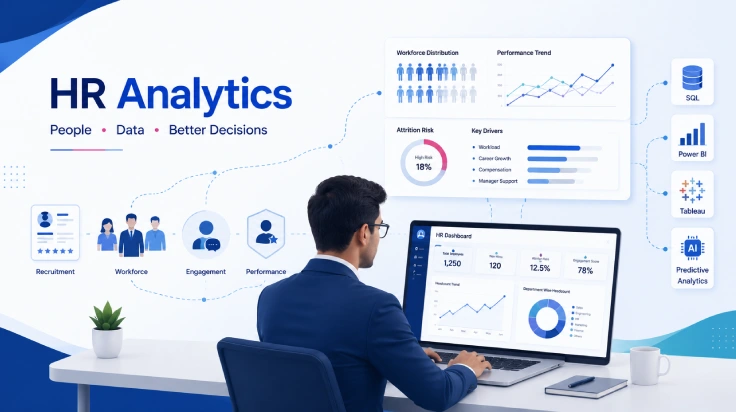
HR decisions used to lean heavily on experience, intuition, and precedent. That works—until the workforce becomes large, distributed, fast-changing, and regulated. HR analytics is the shift from “I think” to “the data suggests,” so hiring, retention, performance, and learning decisions can be tested, compared, and improved over time.
A useful way to frame hr analytics: it is not a software trend; it is an evidence-based management approach applied to people questions—using structured data, statistical thinking, and clear decision rules.
What is HR analytics?
HR analytics is the systematic use of workforce data to measure and explain HR outcomes (such as hiring efficiency, retention, performance, learning impact, and workforce costs), forecast what is likely to happen next, and recommend actions that improve outcomes, while ensuring results are interpretable, fair, and compliant.
Quick facts that make HR analytics worth taking seriously
- In Deloitte’s Global Human Capital Trends (People Analytics chapter), 71% of companies rated people analytics as a high priority, but data readiness was weak—only 8% reported having usable data, and only 15% had broadly deployed HR/talent scorecards to line managers.
- India’s HR analytics market has been estimated at USD 100.1M (2022) and projected to reach USD 379.6M by 2030 (CAGR 18.1%), reflecting rising demand for analytics capabilities and tooling.
- India’s HRMS market is also expanding (a proxy for HR digitisation): IMARC estimates USD 1.1B in 2024, projected USD 4.3B by 2033 (CAGR 14.6%).
- Turnover is expensive even in “normal” roles: Center for American Progress reports a typical (median) turnover cost of ~21% of annual salary across many roles (excluding certain executive/physician cases), with wide variation by job type and skill level.
These numbers point to the real constraint: it’s rarely a lack of interest. It’s data quality, measurement design, and decision discipline.
Editorial Note: This guide references publicly available reports and guidance from Deloitte, IMARC, the Center for American Progress, India's Digital Personal Data Protection Act (DPDP), and other trusted sources. Salary estimates are directional and vary by industry, experience, employer, and location.
Why HR analytics is important?
Let us delve into the reason why HR analytics is so important to have witnessed such massive growth:
1) HR is a measurable performance system, not only a “people function”
- HR influences outcomes that finance and strategy care about: revenue productivity per head, attrition cost, hiring speed, service quality, risk controls, and compliance. Analytics makes these links explicit, so HR interventions can be treated like any business intervention—measured, refined, and scaled.
2) HR data now sits under stronger privacy expectations
- Workforce analytics uses personal data (performance, attendance, compensation, health-related leave signals, location logs, survey responses). India’s Digital Personal Data Protection Act, 2023 sets expectations around notice, purpose limitation, and consent standards (free, specific, informed, unambiguous), plus the right to withdraw consent.
In parallel, global AI governance principles emphasise privacy, fairness, and non-discrimination—relevant when analytics affects hiring, promotion, and pay decisions.
3) “People analytics” is increasingly interdisciplinary
The strongest HR analytics teams borrow methods from:
- Statistics / econometrics (causal inference, experiment design)
- Industrial–organizational psychology (measurement validity, survey design)
- Operations research (capacity planning, staffing optimisation)
- Data science (prediction, NLP on text feedback)
- Policy/compliance (privacy, fairness, documentation)
What are the 4 types of HR analytics?
HR analytics is the systematic use of workforce data to measure and explain HR outcomes, forecast what is likely to happen next, and recommend actions. Their types are listed below:
- Descriptive analytics- What happened? (e.g., attrition rate, time-to-hire, absenteeism trends)
- Diagnostic analytics- Why did it happen? (e.g., drivers of churn by role/manager/tenure)
- Predictive analytics- What is likely next? (e.g., flight-risk forecasting, staffing forecasts)
- Prescriptive analytics- What should we do? (e.g., which intervention reduces churn with lowest cost)
Key takeaway: Many organisations aspire to predictive/prescriptive, but maturity often stalls because usable, integrated data is limited.
HR analytics examples
Below are examples that read “academic + interview-ready” because they state the problem, metric, method, and decision:
- Attrition Diagnostics: model attrition by cohort (tenure bands), segment by role/team/manager change, test associations with compensation position, internal mobility, and workload proxies; output: driver ranking + intervention plan.
- Hiring Funnel Efficiency: compute conversion rates from source → shortlist → interview → offer → joining; compare across roles and locations; output: bottleneck identification + SLA redesign.
- Quality of Hire: build proxy metrics at 6 and 12 months (performance rating, early promotion, probation outcomes) and compare by sourcing channel and assessment stage; output: sourcing strategy + assessment redesign.
- Learning Effectiveness: evaluate training using pre/post performance metrics and matched cohorts; output: programs to scale vs discontinue.
- Pay equity and consistency: test pay dispersion for comparable roles/levels controlling for tenure and performance; output: pay adjustment prioritisation and policy guardrails.
- Workforce Planning: forecast capacity needs by demand signals and productivity metrics; output: headcount plan + skills gap map.
Interesting fact: Deloitte noted recruiting as the #1 people analytics focus area, followed by performance measurement, compensation, workforce planning, and retention—showing where organisations see the fastest measurable ROI.
HR analytics benefits
Organisational benefits
- Faster, higher-quality hiring through funnel optimisation and predictive sourcing
- Lower avoidable attrition by targeting retention levers instead of broad, expensive programs
- More consistent performance systems (less rating inflation/deflation; clearer criteria)
- Better learning ROI (training tied to outcomes, not attendance)
- Fairer decision processes via monitoring bias patterns and policy compliance
Individual benefits (students/young professionals)
- Stronger employability through a rare combo: HR domain + analytics + communication
- Clearer pathways into HR roles that are decision-facing (not only operations)
- A portfolio-friendly domain (dashboards + analysis notes + insight memos)
HR analytics tools
HR analytics is a pipeline: capture → clean → analyse → visualise → act. Tools map to each stage.
Core tools (most job descriptions expect these)
- Excel/Sheets: pivots, cohort analysis, basic dashboards
- Power BI / Tableau: dashboards with drill-downs, stakeholder reporting
- SQL: extracting, joining, and validating HRIS/ATS/LMS data
Advanced tools (useful once fundamentals are strong)
- Python/R: prediction, text analytics (survey comments), experiments, automation
- HRIS/ATS/LMS platforms: context for how data is generated and where it breaks
Table: tool → what it’s used for → what recruiters look for
| Tool | What you do with it in HR analytics | Recruiter “signal” |
|---|---|---|
| Excel | cleaning, pivots, cohorts, simple KPIs | speed + logic |
| SQL | joins, filters, validation checks | data independence |
| Power BI/Tableau | dashboards + stakeholder views | communication clarity |
| Python/R | prediction, NLP, automation | depth + scalability |
| HRIS/ATS/LMS | understand data flow and limitations | domain maturity |
What skills are needed for HR analytics?
Listed below are the skills needed for HR analytics. Have a look at them:
1) Measurement literacy (the “academic” edge)
- Define metrics precisely (numerator/denominator, inclusion rules)
- Understand validity (does the metric measure what it claims?)
- Handle bias and confounding (avoid false conclusions)
2) Data literacy (the “execution” edge)
- Cleaning + standardisation (job titles, departments, levels)
- Missing data handling and QA checks
- Reproducible reporting (same logic every month)
3) Decision literacy (the “business” edge)
- Translate insights into actions and trade-offs
- Quantify impact (cost, time, risk)
- Present with uncertainty (confidence, assumptions, limitations)
HR Analytics vs People Analytics vs Workforce Analytics
Each area of work serve different business objectives. HR Analytics focuses on improving HR processes, People Analytics emphasizes employee behaviour and experience, while Workforce Analytics supports organization-wide planning and workforce optimization.
| Aspect | HR Analytics | People Analytics | Workforce Analytics |
|---|---|---|---|
| Primary Focus | HR processes & performance | Employee behaviour & experience | Organization-wide workforce planning |
| Common Use Cases | Hiring, retention, learning, performance | Engagement, productivity, wellbeing | Headcount planning, capacity, skills forecasting |
| Key Users | HR Teams | HR & Business Leaders | Leadership & Workforce Planning Teams |
| Business Goal | Improve HR decision-making | Enhance employee experience | Optimize workforce strategy |
Common mistakes in HR analytics (and how to fix them)
When it comes to analysis of data to reach at a decision, issues can arise. Some of them are listed below:
- Mistake: dashboards without decisions
- Fix: every report ends with “so what?” and a recommended action.
- Fix: every report ends with “so what?” and a recommended action.
- Mistake: confusing correlation with causation
- Fix: use careful language (“associated with”) and propose tests/experiments.
- Fix: use careful language (“associated with”) and propose tests/experiments.
- Mistake: ignoring data readiness
- Fix: invest in standard definitions, data dictionaries, and validation rules—Deloitte flagged data usability as a major constraint across organisations.
- Fix: invest in standard definitions, data dictionaries, and validation rules—Deloitte flagged data usability as a major constraint across organisations.
- Mistake: building models that can’t be governed
- Fix: prioritise interpretability, documentation, and fairness checks—especially when decisions affect livelihoods.
HR analytics jobs in India (roles + salary ranges)
Common roles for HR analytics in India are as follows:
- HR Analyst / People Analytics Analyst / Workforce Analytics Analyst
- Talent Analytics (recruitment analytics)
- C&B Analyst (analytics-heavy in many firms)
- HRIS Analyst (systems + reporting + data governance)
- Workforce Planning Analyst
Salary reality (India, Glassdoor benchmarks):
HR Analytics salary is based on publicly available salary benchmarks from Glassdoor (India) and industry datasets (accessed July 2026),
- HR Analyst: typical pay range ~₹4.5L–₹8.3L (India) with higher percentiles above that.
- HR Analytics (role label): typical pay range ~₹4.8L–₹12.0L (India), based on limited sample sizes.
- People Analytics Specialist: typical pay range ~₹11.8L–₹25.1L (India), again with small sample sizes—treat as directional.
Key takeaway: Salary depends less on the title and more on scope—whether the role is (a) reporting-only, (b) insight + stakeholder decisions, or (c) modelling + governance.
Industries Using HR Analytics
HR Analytics is widely adopted across industries that manage large, dynamic workforces and rely on data-driven talent decisions.
- IT & Technology - Hiring analytics, skills mapping, workforce planning.
- Banking & Financial Services (BFSI) - Attrition prediction, compliance, performance management.
- Consulting - Resource allocation, talent optimization, project staffing.
- Manufacturing - Shift planning, productivity tracking, workforce forecasting.
- Retail & E-commerce - Seasonal hiring, employee retention, store performance.
- Healthcare - Staff scheduling, workforce utilization, talent retention.
- E-commerce & Startups - Recruitment analytics, employee engagement, scaling teams.
- Global Capability Centres (GCCs) - Talent intelligence, succession planning, people analytics, and global workforce management.
HR analytics courses: How to Choose?
A structured selection rubric (score 0–2 each):
- Goal clarity: HR leadership vs analytics specialist vs HRIS/data track
- Portfolio output: does it force projects (dashboards, insight memos)?
- Breadth: HR fundamentals + analytics + business context
- Time and flexibility: short course vs degree program
- Credibility needs: do employers in your target segment prefer a master’s credential?
Where an MBA fits: If your target is HR leadership roles where analytics is a core skill (not the entire job), an MBA with HR specialisation can be a sensible structure. UPES Online’s MBA (HR specialisation) explicitly positions coverage of HR analytics, digitisation, and data visualisation within its program framing.
Key takeaways
- HR analytics is evidence-based HR decision-making, not “reporting.”
- Most organisations struggle less with tools and more with data usability and definitions.
- Market signals in India suggest rising demand for HR analytics capability and HR tech adoption.
- The best early-career advantage is a portfolio: dashboard + insight memo + clear metrics.
Conclusion
Choose one focus area like attrition or the hiring funnel, and define five clear metrics with formulas. Build a one-page Excel-to–Power BI dashboard and add a brief “insight + action” summary. Then compare HR Analyst vs Talent Analytics vs HRIS roles, map the required tools/skills, and pick a course path that matches your target role. If you want a degree pathway that keeps HR leadership central while adding analytics vocabulary and frameworks, UPES Online’s MBA in Human Resource Management is one option to evaluate against your time and career intent.
FAQs (India search behaviour)
1) What is HR analytics?
- HR analytics is the use of workforce data to measure, explain, and improve HR outcomes (hiring, retention, performance, learning). It adds evidence and decision discipline to HR.
2) What is hr analytics used for?
- Common uses include attrition analysis, hiring funnel optimisation, workforce planning, learning ROI, and pay consistency checks.
3) What are the 4 types of HR analytics?
- Descriptive, diagnostic, predictive, and prescriptive—moving from “what happened” to “what action should be taken.”
4) What skills are needed for HR analytics?
- Measurement skills (good metrics), data skills (Excel/SQL/BI), and decision storytelling (clear recommendations and trade-offs).
5) Which HR analytics tools should I learn first?
- Excel + one BI tool (Power BI/Tableau) + basic SQL. Python/R becomes valuable once fundamentals are stable.
6) Are HR analytics jobs available for freshers in India?
- Yes—typically as HR Analyst, reporting/HR ops analytics, recruitment analytics, or HRIS analyst roles. Portfolio projects help more than generic certificates.
7) Is HR analytics the same as HRMS?
- No. HRMS is the system layer. HR analytics is the measurement and decision layer that uses HRMS/ATS/LMS data.
8) Is HR analytics “safe” under privacy laws?
- It can be, if it follows purpose limitation, consent/notice standards, access controls, and minimises sensitive data exposure—principles aligned with India’s DPDP Act and global AI governance norms.
UPES Online Admission Enquiry
Recommended Courses



Latest Blogs
Online B.Com Scope in 2026: Benefits, Careers, Salaries & Is It Worth It?
Explore online B.Com scope in 2026, including benefits, career options, salaries, industries, higher studies and whether an online B.Com degree is worth it.
Read MoreJul 31, 2026 I 11 mins
MBA for Working Professionals: Eligibility, Fees, Specializations & Career Scope
Explore a detailed guide on MBA for working professionals including eligibility, fees, online MBA options, top specializations, career scope & how to apply.
Read MoreAug 15, 2026 I 13 mins
Is Online MCA Worth It in 2026? Fees, Eligibility, Jobs & Colleges
Find out whether an Online MCA is worth it in 2026. Explore eligibility, fees, specializations, colleges, career scope, salaries and UGC validity.
Read MoreAug 29, 2026 I 11 mins
Online MBA for Engineers: Specializations & Career Scope
Find out if online MBA for engineers is a good choice; explore top specializations and career scope.
Read MoreSep 8, 2026 I 11 mins
How to Identify Online Fake Universities & Degree Scams
Check the UGC fake university list 2026 and learn how to verify an online university, course entitlement, and whether a degree certificate is original or fake.
Read MoreSep 23, 2026 I 10 mins
How to Become a Project Manager with Online MBA in India: Detailed Guide
Learn how to become a project manager in India, including qualifications, skills, certifications, salary, career path & how an Online MBA can support it.
Read MoreSep 28, 2026 I 10 mins
Top Reasons to Pursue Online MBA in Finance
Explore top 10 benefits of an online MBA in Finance, including flexibility, finance skills, career opportunities, salaries, and who should pursue it.
Read MoreSep 29, 2026 I 10 mins
Related Articles

Why Should I Choose UPES Online? 10 Reasons Why
Explore why UPES Online stands out in online education. Learn about flexible learning, UGC-approved degrees, expert faculty & credible online programs. Enroll now!
Read Blog
How to Secure the Privacy of your Applicant’s and Employee’s Data
Explore best practices to protect applicant & employee data. Learn about privacy frameworks, legal compliance, cybersecurity, ethical data handling.
Read Blog
MBA HR Syllabus and Career Scope
Learn all about MBA HR syllabus, exciting career paths & booming job demand. Explore various HR job roles, career graph & what you can do with MBA HR degree.
Read Blog
BBA HR Salary & Job Trends 2026
Explore BBA HR salary & job trends in 2026. Get insights on roles, salary growth, skills for career advancement in human resources. Stay ahead!
Read BlogWhy Should I Choose UPES Online? 10 Reasons Why
Explore why UPES Online stands out in online education. Learn about flexible learning, UGC-approved degrees, expert faculty & credible online programs. Enroll now!
Read BlogHow to Secure the Privacy of your Applicant’s and Employee’s Data
Explore best practices to protect applicant & employee data. Learn about privacy frameworks, legal compliance, cybersecurity, ethical data handling.
Read BlogMBA HR Syllabus and Career Scope
Learn all about MBA HR syllabus, exciting career paths & booming job demand. Explore various HR job roles, career graph & what you can do with MBA HR degree.
Read BlogBBA HR Salary & Job Trends 2026
Explore BBA HR salary & job trends in 2026. Get insights on roles, salary growth, skills for career advancement in human resources. Stay ahead!
Read Blog