Courses
MBA
MCA
BBA
BCA
B.Com
Certifications

Online MBA and Regular MBA are both UGC-recognized postgraduate management degrees, but they differ in learning mode, admission process, flexibility, campus experience, and overall cost. The Government of India continues to expand Online Learning (OL) and Open & Distance Learning (ODL) under UGC regulations and NEP 2020, with several colleges now offering flexible online learning options. An online MBA course remains one of the most popular postgraduate courses, offering working professionals and students a flexible, cost-effective way to pursue a professional degree without compromising their careers. While online MBA courses are popular, many applicants remain skeptical about whether it is a better choice than a regular MBA program. In this article, we will provide a detailed online MBA vs regular MBA comparison and key differences between both courses.
Let’s have a look at a quick comparison between online MBA and regular MBA programs from the table given below:
| Particulars | Online MBA | Regular MBA |
|---|---|---|
| Course delivery | Through online channels such as LMS (Learning Management Systems), live classes, recorded lectures, and e-books. | Regular physical classes hosted on a campus |
|
Duration |
2 years | 2 years |
|
Eligibility |
UG degree with a minimum of 50% marks. Generally, entrance exam scores are not required. | UG degree with a minimum of 50% marks. Most colleges require students to clear management entrance exams such as CAT, XAT, GMAT, etc. |
|
Fees |
Affordable option (typical range INR 2 to 3 lakh) | Higher fees (typical range INR 20-25 lakh) |
|
Industry acceptance |
Widely accepted across all industries for job applications | Widely accepted across all industries for job applications |
|
Best suited for |
Working professionals & students looking for affordable and flexible MBA programs | Graduates looking for comprehensive management programs |
There are several types of MBA programs, such as Regular MBA, Online MBA, Part-time MBA, Executive MBA, and Distance MBA. However, these programs may differ in terms of admission requirements, fee structure, and mode of program delivery. The following are different types of MBA programs:
A Master of Business Administration, or MBA, is a 2-year postgraduate program that offers students in-depth knowledge of business management concepts. The program prepares students for managerial positions across different sectors such as consulting, FMCG, retail, sales & marketing, etc. Typically, graduates are required to clear management entrance exams such as CAT, MAT, XAT, GMAT, etc. to secure admission to top management colleges in India. While the fee structure may vary depending on different colleges, typical fees for a regular MBA range from 20 to 25 lakhs for the entire course. The following are some of the key highlights of a regular MBA course:
An online MBA is a 2-year postgraduate management degree program that is delivered entirely in online mode. Generally, the program is delivered through Learning Management Systems (LMS), where students can attend online classes, watch recorded lectures, access study materials, and download e-books. In most cases, students are not required to appear for an MBA entrance exam to secure admission to an online MBA course. However, most colleges require students to have completed a UG degree with 50% marks. In India, universities and colleges that are entitled by UGC-DEB can grant online MBA degrees; therefore, it is important to verify the status of the college before applying. The following are some of the key highlights of the online MBA course:
A part-time MBA program is a flexible postgraduate program designed to offer higher studies to working professionals and graduates. The duration of a part-time MBA course may vary depending on the program structure and colleges. Typically, colleges conduct in-person classes on weekends or evening sessions. Let’s have a look at the key features of part-time MBA courses:
A Distance MBA is offered through Open and Distance Learning (ODL) mode. Learning may involve self-learning materials, digital resources, and learner-support activities depending on the university. ODL and Online Learning are separate modes under UGC regulations, so students should verify the specific program and mode on UGC-DEB before enrolling. Key features of distance MBAs include the following:
An Executive MBA is an advanced management program designed for working professionals, managers, and business leaders. The duration of the course may vary from 1 to 2 years, and professionals are required to attend regular in-person classes and maintain attendance throughout the program. Let’s discuss key features of an executive MBA program:
Online and Regular MBA programs can both cover core management disciplines such as finance, marketing, operations, strategy, and human resources, but the exact curriculum, electives, projects, and learning experience vary by university and program. We have provided a detailed comparison between the two:
| Parameter | Online MBA | Regular MBA |
|---|---|---|
|
Course Delivery |
Delivered entirely online through live classes, recorded lectures, digital learning platforms, discussion forums, and virtual assessments. Offers flexibility to learn from anywhere. | Delivered through on-campus classroom sessions with fixed schedules, face-to-face interactions, seminars, workshops, and in-person assessments. |
|
Eligibility Criteria |
Bachelor's degree from a recognized university (typically with a minimum of 50% marks, depending on the institution). Most programs do not require entrance exams and may accept both fresh graduates and working professionals. | Bachelor's degree from a recognized university. Admission often requires entrance exams such as CAT, XAT, MAT, CMAT, or university-specific tests, followed by interviews or group discussions. |
|
Curriculum |
Covers core management subjects and industry-relevant specializations similar to regular MBA programs. Many universities incorporate case studies, capstone projects, and industry-led sessions. | Offers a comprehensive curriculum with classroom-based learning, live projects, internships, industry visits, and experiential learning opportunities. |
|
Learning Experience |
Offers self-paced and flexible learning with live and recorded sessions, peer discussions, online networking events, and digital collaboration tools. Requires strong time management and self-discipline. | Provides an immersive campus experience, including classroom discussions, extracurricular activities, industry interactions, networking events, and hands-on learning opportunities. |
|
UGC Recognition |
Verify the HEI, specific program, Online mode, and academic session through UGC-DEB | Verify the university/institution and program through applicable regulatory/institutional sources |
|
Fees |
Generally, more affordable, with fees ranging from approximately INR 1 lakh to INR 3 lakh for the entire program, depending on the university and specialization. | Typically, more expensive, with fees ranging from approximately INR 20 lakh to INR 25 lakh or more at leading business schools in India. |
|
Flexibility |
High flexibility, as students learn at their own pace. (Generally, regular attendance is not required.) | Structured program, as students are required to maintain strong attendance in lectures, projects, and lab work. |
|
Faculty interaction |
Limited faculty interaction; most correspondence occurs over email and virtual modes. | Students interact with faculty through in-person classes and assignments. |
|
Career Opportunities |
Suitable for working professionals seeking career advancement, managerial roles, promotions, or industry transitions without leaving their jobs. Recognized online MBA degrees are accepted across many private sector organizations. | Well-suited for fresh graduates and early-career professionals seeking campus placements, internships, and full-time managerial roles across industries. |
Also check: Online Degree vs Offline Degree: Key Aspects to Consider Before Choosing
An Online MBA is an ideal choice for:
A Regular MBA is an ideal choice for:
Under Regulation 22 of the UGC (Open and Distance Learning Program and Online Programs) Regulations, 2020, undergraduate and postgraduate degrees earned through recognized Online/ODL programs that meet applicable UGC requirements are treated as equivalent to conventional-mode awards. Academic equivalency does not imply that all Online and Regular MBAs have the same curriculum, learning experience, networking environment, or placement ecosystem. Students should use UGC-DEB to confirm their particular university, program, mode, and academic session.
An online MBA and a regular MBA both have their own unique benefits and limitations. While a regular MBA is best suited for full-time students and fresh graduates, an online MBA offers working professionals an opportunity to upskill and expand their career prospects.
In the following section, we have provided detailed pros and cons for pursuing a regular MBA program.
Pros:
A regular MBA program offers a comprehensive and structured MBA curriculum that supports strong networking opportunities and immersive campus life. The following are some of the main benefits of pursuing a regular MBA:
1. Strong networking opportunities: During a regular MBA program, students interact with faculty members, attend in-person seminars, conferences, and make lasting networks and connections with their peers.
2. Structured curriculum: A regular MBA program follows a structured curriculum with dedicated hours for classes, internal assessments, assignment work, and attendance requirements. This allows students to stay on track and have a disciplined schedule for academic activities.
3. Vivid campus experience: During a regular MBA program, students engage in different campus activities, clubs, and events, offering them an immersive experience.
Cons:
Regular MBA programs also have some key limitations, such as:
1. Expensive course cost: A regular MBA program may be a very costly investment for students. Typically, an MBA degree from a tier 1 and tier 2 B-school in India can cost students up to INR 20 to INR 25 lakhs, which can put significant financial strain on students.
2. Less flexibility: During a regular MBA program, students get limited flexibility as they are required to maintain attendance and appear in regular classes.
3. Potential loss of income: Working professionals planning to join regular MBA programs often must make the tough choice of quitting their jobs to join a full-time offline on-campus course.
Online MBA programs are known for offering students flexibility and an option to continue higher education without compromising careers. The following are some of the key benefits of online MBA programs:
Pros:
An online MBA has various benefits, including:
1. No career break: An online MBA allows students to join a postgraduate degree program without having to lose their jobs.
2. Highly flexible: Online MBA programs are specifically designed to cater to working professionals and therefore allow students to learn at their own pace.
3. Cost-effective: An online MBA program is a cost-effective post-graduation option for working professionals. Typically, an online MBA degree's fees in India can cost up to 1 to 3 lakhs.
4. Real-time applications: Working professionals can utilize their MBA learnings in their current jobs and gain real-time applications and industry exposure.
Cons:
Some of the key limitations of online MBAs include the following:
1. Less networking: Online MBA programs are mostly completed virtually, where students have little in-person interaction with other students and faculty.
2. Challenging academic balance: Working professionals often find it difficult to manage their professional commitments and academic responsibilities.
3. Technology requirement: Most online MBA courses are administered through Learning Management Systems (LMS) and may require students to have a laptop and a stable internet connection, which can pose a challenge for students residing in remote areas or those with limited resources.
Both Online and Regular MBA graduates can pursue management and business career paths, but actual opportunities depend on prior experience, specialization, skills, institution, employer requirements, and the program's career-support ecosystem.
There is no particular salary range for online MBA or regular MBA graduates. Compensation is determined by prior experience, work role, specialization, employer, industry, geography, talents, and institution. Full-time MBA placement reports and wages for experienced Online MBA students reflect different candidate demographics; hence, they should not be compared as equivalent salary datasets.
MBA graduates can pursue diverse career opportunities across industries after completing their MBA degree. The following are some of the highest-paying jobs one can pursue after completing an MBA:
| Job Role | Indicative Salary Range in India | Suitable for | Popular MBA Specializations |
|---|---|---|---|
|
Business Development Manager |
INR 7.7 to 8.5 LPA | Early- to mid-career professionals; experience requirements vary | Marketing, Sales |
|
Marketing Manager |
INR 12.6 to 13.9 LPA | Mid-Level Professionals | Marketing Management, Digital Marketing |
|
Product Manager |
INR 21.9 to 24.3 LPA | Experienced Professionals | Business Analytics, Marketing, IT |
|
Business Analytics Manager |
INR 23.8 to 26.3 LPA | Professionals with analytics skills | Business Analytics |
|
Investment Banking Associate |
INR 16.1 to 17.8 LPA | Top B-school Graduates & Experienced Professionals | Finance |
|
Strategy Consultant |
INR 25 to 27.6 LPA | Experienced Professionals | Strategy, General Management |
|
Operations Manager |
INR 10.8 to 12 LPA | Manufacturing, Logistics & Supply Chain Professionals | Operations Management |
|
Human Resources Manager |
INR 10.3 to 11.4 LPA | HR Professionals | Human Resource Management |
|
Supply Chain Manager |
INR 14.6 to 16.1 LPA | Manufacturing, Retail & E-commerce Professionals | Logistics & Supply Chain Management |
|
IT Project Manager |
INR 17.9 to 19.8 LPA | IT Professionals | IT Management, Information Systems |
|
Senior Product Manager |
INR 35.8 to 39.6 LPA | Senior Professionals | Business Analytics, Marketing |
|
General Manager |
INR 36.4 to 40.3 LPA | Senior Managers | General Management |
Note: Salaries for different roles may vary based on several factors, including roles, experience, skills, etc. The above-mentioned figures are taken from AmbitionBox data.
The choice between an online MBA and a regular MBA depends on your current career prospects, personal goals, and financial preferences. Therefore, while making a choice, you must consider the following:
| If You Are... | Online MBA | Regular MBA |
|---|---|---|
| A working professional looking for career growth | Best choice | Not ideal if you cannot take a career break |
|
Looking for flexibility while studying |
Best choice | Less flexible due to fixed schedules |
|
Unable to leave your current job |
Best choice |
Requires full-time commitment in most cases |
|
Looking for a cost-effective MBA |
Best choice |
Higher tuition and living costs |
|
Planning to upskill while earning |
Best choice | May require sacrificing income during the program |
|
Interested in a higher ROI for experienced professionals |
Best choice | Depends on the institution and placement outcomes |
|
Prioritizing networking and peer interactions |
Good (virtual networking) | Best choice |
|
Looking for internships and placement assistance |
Available in some programs | Stronger placement ecosystem |
|
A fresh graduate seeking campus placements |
Limited advantages | Best choice |
|
Seeking a traditional campus experience |
Limited | Best choice |
Students planning their higher studies in management often wonder which course would be best for them: an online MBA or a regular MBA? While both courses offer the same academic skills, they differ from one another in terms of course delivery, fees, and flexibility. If you are a working professional, an online MBA will give you the flexibility to learn new skills, expand career opportunities, and upskill industry expertise all without having to lose your job; on the other hand, a regular MBA offers a comprehensive classroom and interactive learning experience and is generally well suited for fresh graduate students.
Which mode is best for MBA online or offline?
Neither of the two is subjectively better than the other, as they differ from one another in terms of course delivery, fee structure, and objective. The choice totally depends on your needs. Online MBA programs are generally best suited for working professionals who want to experience a flexible learning environment while also fulfilling their professional duties. On the other hand, a regular or offline MBA is typically a good choice for graduate students who are required to attend on-campus classes and academic activities.
Is an online MBA equal to an offline MBA?
An online MBA is academically equal to an offline MBA as they follow the same curriculum and subjects. Additionally, both courses also offer valid degrees that students can use to advance their careers. However, the courses differ from each other in terms of delivery modules and fee structures, as online courses are delivered through an LMS and offline courses via regular in-person classes. Furthermore, online MBA programs are much more cost-effective than regular MBA programs.
Why is an online MBA better than an offline MBA for working professionals?
Working professionals generally prefer online MBA programs as they offer complete flexibility to study without professionals having to quit their jobs. Online MBA programs allow professionals to learn at their own pace as attendance is generally not compulsory, and professionals don’t have to visit campus on a regular basis. Furthermore, these programs also help professionals to apply their learning to current jobs, expand their career prospects, and career switch opportunities.
Does an online MBA provide placement?
Yes, several online MBA colleges offer students placement support and have strong alumni distinctions. Students can participate in college placements and secure high-paying jobs.
Is an online MBA worth it in 2026?
Yes, an online MBA is considered an excellent PG management course in 2026, especially for working professionals who can pursue a PG level degree without quitting their current jobs. The online MBA program offers a cost-effective higher education option for professionals by giving them flexibility to learn at their own pace. According to a GMAC report, 54% of global recruiters consider online MBA graduates and full-time MBA graduates equally, indicating that employer focus is increasingly on skills, experience, and business impact rather than delivery mode.
Does an online MBA increase salary?
Yes, an online MBA program helps working professionals to upgrade their skills and earn better salaries. According to an industry report by GMAC, online MBA graduates are able to recouped their investments within two and a half years of the completion of the course.






Choose the best online MBA programs at UPES Online. Learn about specializations, career scope, & why professionals choose UPES for flexible learning.
Read MoreOct 15, 2025 I 6 mins
General MBA vs specialized MBA compared on metrics like scope, ROI, salary & career growth in India. Understand the path & choose wisely.
Read MoreMay 3, 2026 I 8 mins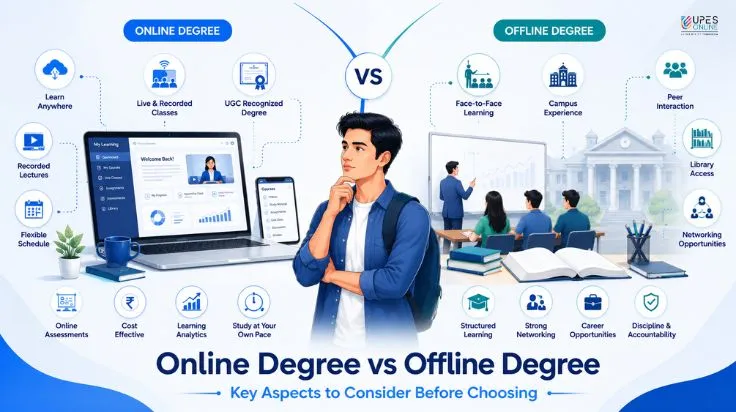
Compare online degree vs offline degree based on flexibility, costs, career opportunities, recognition, & learning experience to choose the right program.
Read MoreJul 10, 2026 I 9 mins
Explore online B.Com scope in 2026, including benefits, career options, salaries, industries, higher studies and whether an online B.Com degree is worth it.
Read MoreJul 31, 2026 I 11 mins
Explore a detailed guide on MBA for working professionals including eligibility, fees, online MBA options, top specializations, career scope & how to apply.
Read MoreAug 15, 2026 I 13 mins
Find out whether an Online MCA is worth it in 2026. Explore eligibility, fees, specializations, colleges, career scope, salaries and UGC validity.
Read MoreAug 29, 2026 I 11 mins
Find out if online MBA for engineers is a good choice; explore top specializations and career scope.
Read MoreSep 8, 2026 I 11 minsExplore a detailed guide on MBA for working professionals including eligibility, fees, online MBA options, top specializations, career scope & how to apply.
Read Blog
Explore high-paying jobs after an online MBA in India, salary ranges, MBA specializations, skills, and industries for management careers in 2026.
Read BlogGeneral MBA vs specialized MBA compared on metrics like scope, ROI, salary & career growth in India. Understand the path & choose wisely.
Read Blog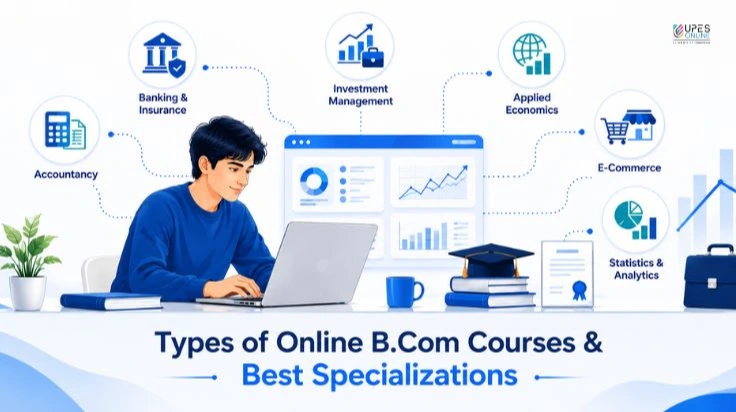
Explore online B.Com courses, top specializations, career opportunities, salaries, & learn how to choose the best online B.Com degree.
Read BlogExplore a detailed guide on MBA for working professionals including eligibility, fees, online MBA options, top specializations, career scope & how to apply.
Read BlogExplore high-paying jobs after an online MBA in India, salary ranges, MBA specializations, skills, and industries for management careers in 2026.
Read BlogGeneral MBA vs specialized MBA compared on metrics like scope, ROI, salary & career growth in India. Understand the path & choose wisely.
Read BlogExplore online B.Com courses, top specializations, career opportunities, salaries, & learn how to choose the best online B.Com degree.
Read Blog