Courses
MBA
MCA
BBA
BCA
B.Com
Certifications
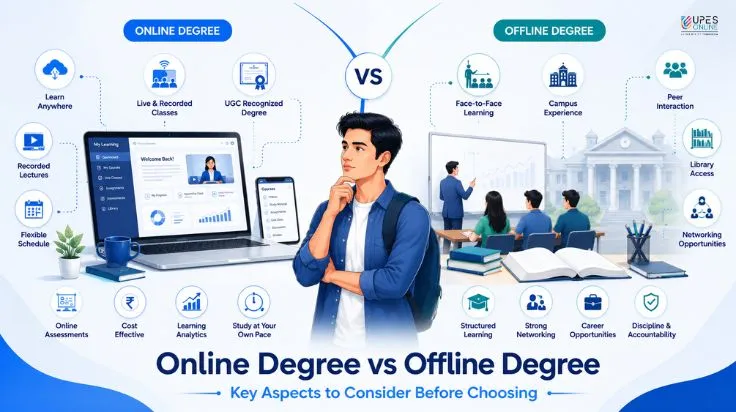
Online and offline degrees both offer recognized qualifications from accredited universities, but they differ in flexibility, learning experience, cost, and accessibility. Online courses are ideal for working professionals and remote learners, while offline degrees provide structured classroom learning and campus exposure.
Online education in India is on the rise, resulting in students opting for more flexible and cost-effective education solutions over traditional degree programs. In 2025, the enrollment rate for online courses among higher education applicants rose to 12%. Professional distance learning courses such as MBA, BBA, and MCA witnessed a steep rise in applications, with online MBA alone accounting for 38% of applications among distance learning programs. These trends have ignited debates among students surrounding online degree vs offline degree courses and which option is the better way forward.
In this article, we have provided a detailed online vs offline degree comparison along with their key benefits and trends.
Both online and offline degrees are largely the same; they offer UGC accredited certifications from recognized universities, which have equal academic value when approved by the relevant regulatory authorities. However, both degrees differ in terms of their mode of delivery and conduct. While online programs typically offer more flexibility to students through online classes, recorded lectures, and proctored assessments, offline degree courses generally require students to physically attend classes and appear for written examinations on campus. Furthermore, distance degree courses often have lower fees compared to offline degree programs. Many working professionals and students seeking flexibility alongside their higher education often opt for an online degree program.
To understand how online and offline degree program differ from each other, let’s deep down with a detailed comparison of both here:
| Factor | Online Degree | Offline Degree |
|---|---|---|
| Mode of learning | Online (Distance learning) | Offline (Physical classes) |
| Fee | Low | Comparably high |
| Exam mode | Online (Remotely proctored) | Offline (Pen and paper based) |
| Attendance criteria | Generally, not compulsory | Generally, compulsory |
| Admission process | Online | In-campus |
| Interactions | Remote interactions with faculty and other students | Face to face interactions |
| Learning materials | Provided through emails, LMS (Learning Management System), e-books, Live classes, and PDFs | Through academic books, lectures |
While traditional offline degrees account for the largest share of higher education enrollments, distance learning degrees are gaining popularity, especially among learners who need flexibility along with their academic journey. For instance, 12% of higher education enrollment in India constitutes distance learning courses, with over 4.3 million students enrolled in distance learning programs across universities. Both modes of degree programs have their distinct advantages, let’s explore them below:
The following are some of the major advantages of distance learning:
The following are some of the key advantages of pursuing an offline degree:
If you are looking for an online course and planning to enroll in a distance learning program, you must ensure you opt for a reliable program supported by a reputed institute. In the following points we have pointed out different factors that you must consider while selecting an online degree program:
As demand for distance learning programs increases, Indian students and professionals are looking for more distance learning courses. Professional courses such as MBA, BBA, and BCom are some of the most sought-after online courses in India. The following is the list of top online degree courses in India:
| Program | Why in Demand | Trends |
|---|---|---|
| Online MBA | Leadership, management, analytics, marketing, finance jobs |
|
| Online BBA | Preferred UG business degree for management careers |
|
| Online BCA | Entry-level tech degree aligned with IT hiring trends |
|
| Online MCA | High demand for software development, AI, cybersecurity, cloud roles |
|
| Online B.Com | Flexible commerce degree with strong employability base |
|
Both online and offline degrees can lead to strong career opportunities when pursued from reputed institutions. Employers increasingly focus on skills, internships, certifications, and practical experience rather than only the mode of education.
Choose online degree if you:
Choose offline degree if you:
There is no universal “better” option between online degree vs offline degree. The right choice depends on your personal goals, financial situation, preferred learning style, and career aspirations.
Online degrees are ideal for flexibility, affordability, and accessibility, while offline degrees offer immersive campus experiences, stronger peer interaction, and structured academic environments. Ultimately, choosing a recognized university and building relevant skills matter more than the mode of education itself.




Choose the best online MBA programs at UPES Online. Learn about specializations, career scope, & why professionals choose UPES for flexible learning.
Read MoreOct 15, 2025 I 6 mins
General MBA vs specialized MBA compared on metrics like scope, ROI, salary & career growth in India. Understand the path & choose wisely.
Read MoreMay 3, 2026 I 8 minsCompare online degree vs offline degree based on flexibility, costs, career opportunities, recognition, & learning experience to choose the right program.
Read MoreJul 10, 2026 I 9 mins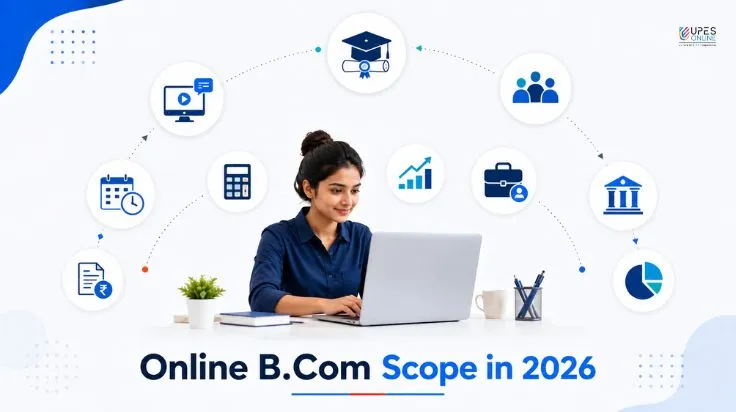
Explore online B.Com scope in 2026, including benefits, career options, salaries, industries, higher studies and whether an online B.Com degree is worth it.
Read MoreJul 31, 2026 I 11 mins
Explore a detailed guide on MBA for working professionals including eligibility, fees, online MBA options, top specializations, career scope & how to apply.
Read MoreAug 15, 2026 I 13 mins
Find out whether an Online MCA is worth it in 2026. Explore eligibility, fees, specializations, colleges, career scope, salaries and UGC validity.
Read MoreAug 29, 2026 I 11 mins
Find out if online MBA for engineers is a good choice; explore top specializations and career scope.
Read MoreSep 8, 2026 I 11 minsGeneral MBA vs specialized MBA compared on metrics like scope, ROI, salary & career growth in India. Understand the path & choose wisely.
Read Blog
Explore online B.Com courses, top specializations, career opportunities, salaries, & learn how to choose the best online B.Com degree.
Read Blog
Compare UPES Online MBA with other top universities. Know why students prefer UPES online over others. Check fee, flexibility, faculty, ROI, & career scope.
Read BlogGeneral MBA vs specialized MBA compared on metrics like scope, ROI, salary & career growth in India. Understand the path & choose wisely.
Read BlogExplore online B.Com courses, top specializations, career opportunities, salaries, & learn how to choose the best online B.Com degree.
Read BlogCompare UPES Online MBA with other top universities. Know why students prefer UPES online over others. Check fee, flexibility, faculty, ROI, & career scope.
Read BlogGeneral MBA vs specialized MBA compared on metrics like scope, ROI, salary & career growth in India. Understand the path & choose wisely.
Read Blog