Courses
MBA
MCA
BBA
BCA
B.Com
Certifications
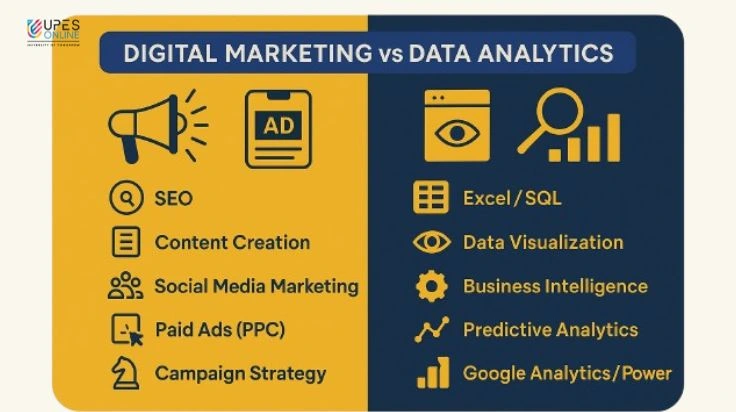
In a digital-first world, the demand for professionals who can drive online growth or analyze data is higher than ever. Two of the most promising career paths in this space are digital marketing and Data Analytics. Both are integral to business success, yet when you compare Digital Marketing Vs Data Analytics, they differ in their approach, tools, and mindset.
This blog will help you understand the key differences, similarities, course structures, tools, specializations, skills, salary prospects, and how to choose the path that aligns with your strengths and goals.
Before comparing the two, it's important to understand what each career entails. This will help you identify which aligns better with your personality, interests, and long-term ambitions.
Digital Marketing focuses on creating and managing campaigns to promote brands, products, or services using online platforms. Data Analytics, meanwhile, revolves around collecting, interpreting, and using data to inform those business strategies and optimize performance.
Understanding the differences between these fields is essential before making a career decision. While both roles work closely together in digital strategy, they serve different functions and require different skill sets.
| Criteria | Digital Marketing | Data Analytics |
|---|---|---|
| Goal | Increase visibility, engagement, and conversions | Measure and improve digital performance |
| Tools Used | Canva, Mailchimp, SEMrush, HubSpot, Google Ads | Google Analytics, Tableau, Excel, Power BI, SQL |
| Focus Area | Campaign creation and execution | Data extraction, reporting, and optimization |
| Mindset Needed | Creative, strategic, audience-focused | Analytical, logical, detail-oriented |
| Outcome | Brand growth and sales | ROI analysis and performance improvement |
While one focuses on communication and engagement, the other works behind the scenes to ensure every decision is backed by data.
In both digital marketing and analytics, tools play a critical role in improving productivity and performance. However, the tools differ significantly in purpose and usage.
Mastery of these tools not only builds expertise but also boosts employability in both career tracks.
A strong academic foundation is essential in both fields. Comparing the course content can help you understand the knowledge and skills you’ll acquire in each program.
If you're aiming to build a successful career in digital marketing, consider enrolling in the BBA/MBA in Marketing Management or the MBA in Digital Business at UPES Online. These programs offer practical, hands-on learning with industry-relevant tools and real-world projects—equipping you with the skills and confidence to be job-ready from day one.
Choosing a specialization early can help you build expertise in a focused area. Both fields offer a variety of domain-specific tracks to suit your interests and career plans.
Specializing in one of these areas can make you stand out in niche job roles and unlock opportunities in high-demand sectors.
Understanding job roles, expected salaries, and industry demand can help you decide which career path has the right ROI for your investment of time and skills.
While both fields offer strong growth, Data Analytics often commands slightly higher starting salaries due to its technical nature.
Both domains offer meaningful avenues for further studies, depending on your interests—whether creative strategy or data science.
For those interested in analytics, the Post Graduate Certificate Program in Data Analytics (Hybrid), the Post Graduate Certificate Program in Data Analytics (Self-paced) as well as Online BCA in Data Analytics at UPES Online offers tool-based learning, mentorship, and career guidance in a flexible format.
Acquiring domain-specific skills is vital for job readiness. Here's what you can expect to learn in each path:
| Digital Marketing Skills | Data Analytics Skills |
|---|---|
| SEO & Campaign Planning | SQL & Python for Data Processing |
| Social Media Engagement | Tableau, Power BI for Visualization |
| Email Automation & Copywriting | Google Analytics & Tag Manager |
| Branding & Strategy | Predictive Modeling & Forecasting |
| Use of digital marketing tools | Business Intelligence Applications |
These skills will prepare you for practical challenges and position you for success in the digital ecosystem.
The answer depends on you—your strengths, career goals, and what you enjoy doing day to day. There is no universally better choice; both are highly relevant and future-focused.
Professionals who master both domains—marketing strategy and data analysis—often rise quickly into leadership and cross-functional roles.
Choosing the right path involves self-reflection and career mapping. Here are a few guiding questions:
Clarity on these aspects will help you confidently select a course and commit to your learning journey.
Digital marketing and Data Analytics are two sides of the same coin—equally vital, yet distinct in execution. As businesses grow increasingly data-driven and digital-first, both career paths promise long-term relevance and growth.
To explore the data side of this digital revolution, consider the variety of courses from UPES Online. With practical training, industry mentorship, and tool-based learning, it’s a powerful starting point for anyone aspiring to build a career in analytics.





Explore online B.Com scope in 2026, including benefits, career options, salaries, industries, higher studies and whether an online B.Com degree is worth it.
Read MoreJul 31, 2026 I 11 mins
Explore a detailed guide on MBA for working professionals including eligibility, fees, online MBA options, top specializations, career scope & how to apply.
Read MoreAug 15, 2026 I 13 mins
Find out whether an Online MCA is worth it in 2026. Explore eligibility, fees, specializations, colleges, career scope, salaries and UGC validity.
Read MoreAug 29, 2026 I 11 mins
Find out if online MBA for engineers is a good choice; explore top specializations and career scope.
Read MoreSep 8, 2026 I 11 mins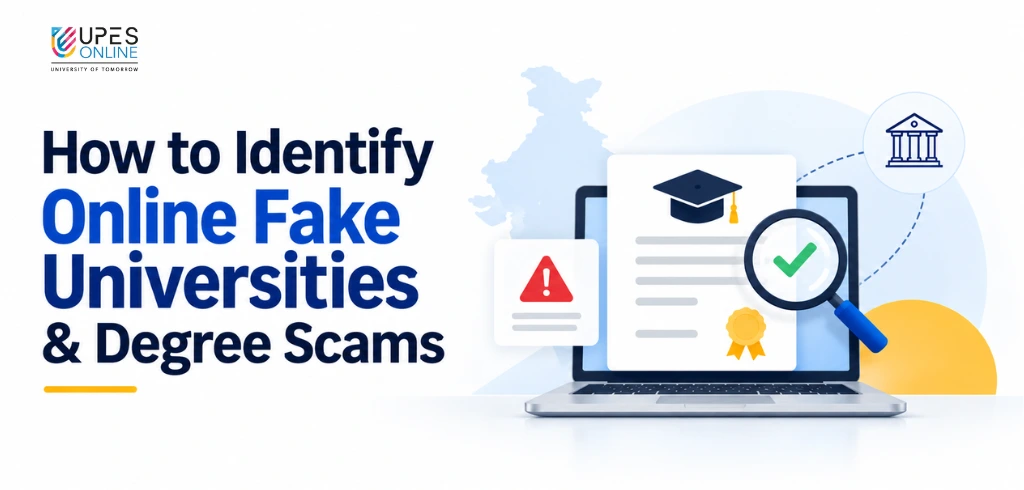
Check the UGC fake university list 2026 and learn how to verify an online university, course entitlement, and whether a degree certificate is original or fake.
Read MoreSep 23, 2026 I 10 mins
Learn how to become a project manager in India, including qualifications, skills, certifications, salary, career path & how an Online MBA can support it.
Read MoreSep 28, 2026 I 10 mins
Explore top 10 benefits of an online MBA in Finance, including flexibility, finance skills, career opportunities, salaries, and who should pursue it.
Read MoreSep 29, 2026 I 10 mins
Compare Online MBA specializations in Finance, Marketing, HR, Business Analytics, Operations and more. Explore subjects, skills and career paths.
Read MoreOct 1, 2026 I 9 mins
Explore MBA in International Business scope in India in 2026, including career opportunities, job roles, salary, hiring industries, key skills.
Read MoreOct 7, 2026 I 8 mins
What is generative AI & how to use it? What tools to work on, applications, examples & use cases in everyday life.
Read Blog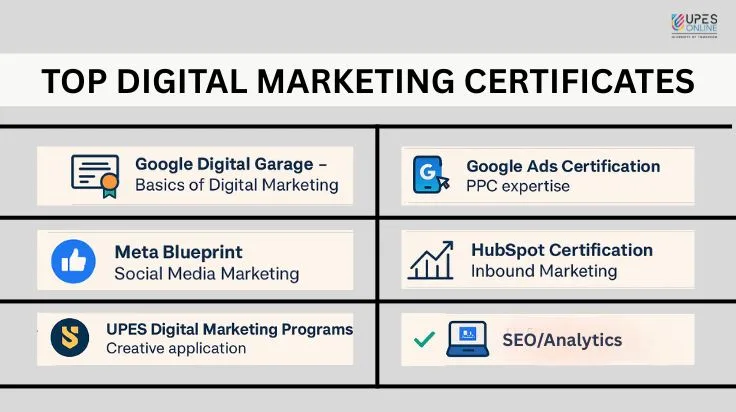
Opt for top digital marketing certifications in 2026 that open doors to high-growth roles. Get expert picks, prep tips & job placement strategies!
Read Blog
Discover latest data analytics techniques & tools to extract meaningful information from complex data sets & make data-driven decisions.
Read BlogWhat is generative AI & how to use it? What tools to work on, applications, examples & use cases in everyday life.
Read BlogOpt for top digital marketing certifications in 2026 that open doors to high-growth roles. Get expert picks, prep tips & job placement strategies!
Read BlogDiscover latest data analytics techniques & tools to extract meaningful information from complex data sets & make data-driven decisions.
Read BlogWhat is generative AI & how to use it? What tools to work on, applications, examples & use cases in everyday life.
Read Blog