Courses
MBA
MCA
BBA
BCA
B.Com
Certifications
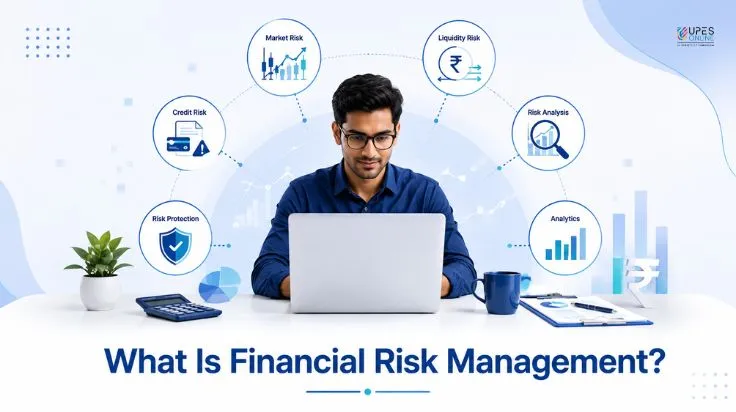
Businesses use Financial Risk Management to ensure the organization’s financial operation remains optimized and runs smoothly. According to the World Economic Forum's Future of Jobs Report 2025, analytical thinking, AI, and risk assessment remain among the fastest-growing skills globally. Financial institutions are increasingly investing in AI-powered risk management systems to improve resilience and regulatory compliance. As Financial Risk Management becomes a mainstream skill, it is essential for students and professionals alike to have a comprehensive understanding of the subject, types, benefits, and detailed process.
Financial Risk Management is a process of ensuring minimum financial losses to an organization’s assets and finances. The Financial Risk Management process uses a structured approach to identify, assess, and mitigate potential financial risk that may arise due to several internal or external factors. Financial Risk Management allows organizations to take proactive measures while making business decisions, ensuring minimum losses and maximum growth and investment opportunities. Unlike enterprise risk management, which takes on a holistic approach in managing any threat or risk that may cause harm to organization, Financial Risk Management is only concerned with protecting an organization's economic value, cash flow, and capital adequacy.
A risk in Financial Management can be defined as an element that may cause threat to financial stability or expected goals of an organization. Financial risks may arise from internal or external factors such as operational inefficiencies or changes in market conditions. Companies use Financial Risk Management frameworks to identify risks and take strategic measures to mitigate its adverse effects on the company’s financial stability.
Enterprise Risk Management is a process of identifying all organizational risks including strategic, operational, and compliance risks. On the other hand, Financial Risk Management is a process of identifying risks that specifically affect a company’s finances. The following table details a comprehensive difference between both:
| Financial risk management | Enterprise risk management |
|---|---|
| Focuses mainly on financial exposure and losses | Covers risks across the entire organization |
| Includes credit, market and liquidity risks | Includes strategic, operational, legal, technological and financial risks |
| Often led by finance, treasury or risk teams | Requires coordination across departments |
| Uses financial models, limits and hedging | Connects risk with strategy, governance and performance |
Also check: MBA Finance Syllabus & Subjects For Students
As per the ISO 31000 Risk Management guidelines, the key characteristics of an effective risk integration include structured implementation, customization, inclusion, adaptability, information quality, human factors, and continual improvement. The following are some of the key principles of Financial Risk Management:
Financial Risk Management is essential for modern businesses as it protects assets, stabilizes cash flows, and minimizes risk of heavy losses to the company. Furthermore, Financial Risk Management also helps organizations plan new ventures, make informed business decisions, and diversify investments. The following table includes key reasons why Financial Risk Management is important:
| Factor | Importance |
|---|---|
| Prevents losses | Catches threats early to stop severe financial damage from market crashes or defaults. |
| Preserves cash flow | Keeps daily operations funded so bills and short-term costs are always met. |
| Withstands shocks | Helps an organization continue operating during interest-rate changes, defaults, market volatility, liquidity shortages or economic disruption |
Based on different factors, Financial Risk Management can be classified into the following types:
Credit risks for financial services companies arise when a borrower fails to repay the loan and results in loan defaults, delayed payments, and corporate bond defaults. Some of the examples of credit risks include:
Companies use methods such as credit checks, credit scoring, collateral, and exposure limits to mitigate credit risks.
Market risks are external risks that arise when the value of companies' assets changes significantly. Some of the common examples of market risks include:
The possibility that a company cannot meet its short-term financial obligations is called liquidity risks. When an organization runs out of cash to pay short-term loans while still owning valuable assets, the organization may face liquidity risk.
Operational risks are caused by internal miscommunications, lack of judgement, or security breaches. Some of the common examples include a cybersecurity attack, fraudulent transactions, discrepancies in reporting, or human error.
A currency risk or foreign exchange risk is a chance that a company will lose money on foreign investment due to sudden changes in currency exchange rates.
While drafting a financial policy, making an investment, or dealing with a financial transaction, companies are required to abide by the legal frameworks as prescribed by governing authorities. Failing to abide by rules may result in penalties, lawsuits, and reputational damage.
The Financial Risk Management process follows a cyclic, structured process of identifying, assessing, measuring, monitoring, and governing a potential financial risk. In the following section, we have detailed the financial risk management process:
Typically, there are four widely used financial risk management techniques by companies:
Financial Risk Management helps businesses in saving money by identifying sudden risks, improving cash flow, and helping managers take informed financial decisions. The following are some of the key benefits of financial risk management:
1. Reduces unexpected financial losses: An effective financial risk management framework uses predictive analytics to identify potential risks based on historical data, seasonality patterns, and market trends. This helps managers avoid sudden financial losses.
2. Improves cash-flow stability: By enabling liquidity forecasting, avoiding unexpected losses, and reducing market shocks, Financial Risk Management ensures steady cash-flow.
3. Supports informed decision-making: An effective and data-driven framework helps managers collect focused informed data and replaces guesswork in decision-making.
4. Protects assets and investments: By ensuring financial stability, steady cash flows, companies are able to not only preserve their valuable assets but also keep long-term investments intact.
5. Improves capital allocation: Financial Risk Management helps businesses direct funds to high-potential areas and safekeep their capital. Furthermore, it also helps in optimizing resource distribution, reducing loss of exposure, and aligning investments with risk-adjusted returns.
6. Strengthens regulatory and internal compliance: A properly aligned governance and policy framework helps businesses avoid costly fines, legal actions, and enables operational controls.
7. Supports business continuity: A steady cash flow, appropriate governance framework, and preventing financial losses help businesses improve continuity and long-term growth.
Financial Risk Managers today use various advanced software and tools to streamline their day-to-day tasks. The applications of software across several industries including banking, finance, and big corporations. The following table lists some of the most popular financial risk management software & tools:
| Software & Tool | Primary Use | Industries Using It |
|---|---|---|
| Murex | Market risk, treasury, derivatives, and capital markets risk management | Banks, investment firms |
| SAS Risk Management | Credit risk, operational risk, regulatory reporting | BFSI, consulting |
| Moody's Analytics | Credit risk modelling, stress testing, risk analytics | Banks, NBFCs, consulting |
| Oracle Financial Services Analytical Applications (OFSAA) | Regulatory compliance, Basel reporting, risk analytics | Banks and financial institutions |
| Bloomberg Terminal | Financial data analysis, market risk assessment | Investment banking, asset management |
| MSCI RiskMetrics | Portfolio and market risk management | Investment firms and mutual funds |
| Situation | Risk | Possible response |
|---|---|---|
| Bank lends to a borrower | Credit risk | Credit assessment, collateral, exposure limits |
| Exporter expects USD payment | Currency risk | FX hedge/forward contract |
| Investment portfolio loses value as rates rise | Market risk | Duration management, diversification, hedging |
| Company lacks cash for upcoming obligations | Liquidity risk | Liquidity reserves, credit facilities, cash-flow forecasting |
| Trading system fails | Operational risk | Controls, redundancy, incident-response procedures |
Financial Risk Management domain offers job opportunities across different profiles including Manager, Analyst, and Associate positions. As per AmbitionBox data, the salaries for these roles in India may vary from INR 10 to 25 LPA. The following table includes some of the top jobs for Financial Risk Management in India along with average salaries:
| Job Role | Key Responsibilities | Average Salaries |
|---|---|---|
| Financial Risk Manager | Identify and mitigate financial risks across business functions | INR 23 to 25 LPA |
| Credit Risk Analyst | Evaluate borrowers' creditworthiness and assess lending risks | INR 12 to 14 LPA |
| Market Risk Analyst | Monitor market fluctuations affecting investments and portfolios | INR 14 to 15 LPA |
| Operational Risk Manager | Manage risks arising from internal processes, systems, and compliance issues | INR 15.5 to 17 LPA |
| Investment Risk Analyst | Analyze portfolio risks and investment performance | INR 13 to 14 LPA |
| Enterprise Risk Manager | Develop organization-wide risk management strategies | INR 16.8 to 18.6 LPA |
| Compliance Manager | Ensure compliance with financial regulations and reporting standards | INR 13 to 15 LPA |
| Quantitative Risk Analyst | Build financial models for risk forecasting and stress testing | INR 20 to 25 LPA |
| Risk Management Consultant | Advise organizations on risk strategies and regulatory compliance | INR 13 to 14 LPA |
| Fraud Risk Analyst | Detect and prevent financial fraud and cyber-related risks | INR 4.4 to 4.8 LPA |
Note: Salaries may vary based on the job title, responsibilities, experience level, and other factors. The salaries provided in the table above are sourced from AmbitionBox.
Financial Risk Manager is a dynamic career path with demand across industries such as banking, finance, FinTech, investment banking, consulting, and more. In the following table we have provided the list of top industries hiring Financial Risk Managers:
| Industry | Roles Offered |
|---|---|
| Banking and Financial Services (BFSI) | Financial Risk Manager, Credit Risk Analyst, Market Risk Manager |
| Investment Banking | Quantitative Risk Analyst, Market Risk Analyst, Treasury Risk Manager |
| Commercial Banking | Credit Risk Manager, Regulatory Risk Manager, Operational Risk Manager |
| Insurance | Enterprise Risk Manager, Insurance Risk Analyst, Compliance Manager |
| Asset Management and Wealth Management | Investment Risk Manager, Portfolio Risk Analyst |
| FinTech | Risk Data Analyst, Fraud Risk Analyst, Model Risk Analyst |
| Consulting Firms | Risk Management Consultant, Regulatory Risk Consultant |
| Credit Rating Agencies | Credit Risk Analyst, Financial Risk Consultant |
| Corporate Finance and Treasury | Treasury Risk Manager, Financial Planning and Risk Specialist |
| Stock Exchanges and Capital Markets | Market Risk Analyst, Compliance and Risk Officer |
| Regulatory and Financial Institutions | Regulatory Risk Specialist, Financial Compliance Manager |
| Technology and Analytics Firms | Financial Analytics Consultant, Risk Modelling Analyst |
| ESG and Sustainable Finance | ESG Risk Analyst, Sustainability Risk Manager |
| E-commerce and Digital Payments | Fraud Risk Analyst, Financial Crime Specialist |
Financial Risk Manager is a top role among risk management jobs and therefore, many aspiring financial professionals often wonder how they can carve out a successful career path in the field. If you wish to become a Financial Risk Manager, the career path may look like the following:
1. Complete higher studies in relevant fields: Students should first complete their bachelors and master's education before applying for financial manager roles. It is preferred that you pursue education in relevant fields. The following are some of the popular courses to become Financial Risk Manager:
| Level | Course |
|---|---|
| Undergraduate Courses | • B.Com (Hons.) Banking and Insurance • BBA Finance Management • B.Sc in Economics |
| Postgraduate Courses | • MBA in Financial Management • M.Sc in Economics • M.Com in Finance |
| Certification Courses | • FRM Certification by GARP • Recognized certification in Financial Risk Management • Short Term Certification Courses in Finance |
2. Complete globally recognized certifications: Many multinational organizations hiring Financial Risk Managers require applicants to have globally recognized certifications (such as FRM Certification by GARP).
3. Work on projects and internships: During your higher education, you should work on projects based on real-world applications and complete industry internships to gain hands-on experience.
4. Build a strong resume: Before applying for jobs, you should build a strong resume that details your career objectives in this domain, skills, experiences, and past projects.
If you wish to pursue a career as a financial risk manager with leading organizations. You are required to possess the following skills:
Also Read: 50 Top Commonly Asked Financial Management Interview Questions
The future of financial risk management is largely driven by automation, ESG principles, and flexible operational frameworks. Organizations across the globe are focused on improving operational efficiency with advanced artificial intelligence, predictive analytics, and tech-driven financial risk management frameworks. According to a recent Deloitte's Future of Risk report, cognitive technologies are expected to augment, and in some cases automate, human decision-making in risk management. Furthermore, ESG and climate change has emerged as a major financial risk factor for global organizations, expanding scope of Financial Risk Management to segments such as Carbon exposure analysis, supply chain risk assessment, sustainability disclosures, climate stress testing, and ESG investment risk evaluation.
As Financial Risk Management shifts from being a reactive domain to predictive, data-driven, and automated field, it will offer promising career opportunities for professionals with skills in risk analytics, regulatory compliance, and emerging technologies, offering opportunities in high paying jobs.
What are the 4 types of financial risk?
What does a Financial Risk Manager do?
What does risk management mean in finance?
What are top jobs in Financial Risk Management?
Is Financial Risk Management a good career in India?




Choose the best online MBA programs at UPES Online. Learn about specializations, career scope, & why professionals choose UPES for flexible learning.
Read MoreOct 15, 2025 I 6 mins
General MBA vs specialized MBA compared on metrics like scope, ROI, salary & career growth in India. Understand the path & choose wisely.
Read MoreMay 3, 2026 I 8 mins
Compare online degree vs offline degree based on flexibility, costs, career opportunities, recognition, & learning experience to choose the right program.
Read MoreJul 10, 2026 I 9 mins
Explore online B.Com scope in 2026, including benefits, career options, salaries, industries, higher studies and whether an online B.Com degree is worth it.
Read MoreJul 31, 2026 I 11 mins
Explore a detailed guide on MBA for working professionals including eligibility, fees, online MBA options, top specializations, career scope & how to apply.
Read MoreAug 15, 2026 I 13 mins
Find out whether an Online MCA is worth it in 2026. Explore eligibility, fees, specializations, colleges, career scope, salaries and UGC validity.
Read MoreAug 29, 2026 I 11 mins
Find out if online MBA for engineers is a good choice; explore top specializations and career scope.
Read MoreSep 8, 2026 I 11 mins
Explore top short-term finance certification courses in 2026. Gain in-demand skills in investment, fintech, & analytics to accelerate your finance career!
Read Blog
Want to break into investment banking? A BBA in Finance equips you with the right skills, knowledge, & network to land top finance roles.
Read Blog
A list of the most frequently asked financial controller interview questions to help you stand out. From technical accounting expertise to leadership skills.
Read BlogExplore top short-term finance certification courses in 2026. Gain in-demand skills in investment, fintech, & analytics to accelerate your finance career!
Read BlogWant to break into investment banking? A BBA in Finance equips you with the right skills, knowledge, & network to land top finance roles.
Read BlogA list of the most frequently asked financial controller interview questions to help you stand out. From technical accounting expertise to leadership skills.
Read BlogExplore top short-term finance certification courses in 2026. Gain in-demand skills in investment, fintech, & analytics to accelerate your finance career!
Read Blog