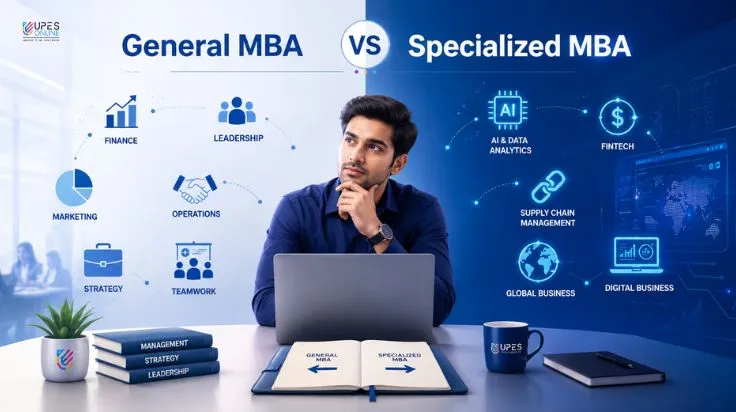
Deciding to pursue an online MBA is a big life move. But once you make that choice, a second, often more stressful question pops up: Should you go for a general MBA vs specialized MBA?
In 2026, with AI, data, and industry-focused roles growing rapidly, the choice directly impacts your salary, career growth, and ROI.
This guide will break down everything from core curriculum differences to salary expectations, helping you decide which path aligns with your long-term career goals.
General MBA vs Specialization: Quick Answer
A General MBA offers broad business knowledge and leadership flexibility, while a Specialized MBA provides deep expertise in a specific domain like finance, analytics, or logistics.
- Choose General MBA if: You want to become a CEO or General Manager and enjoy overseeing diverse departments.
- Choose Specialized MBA if: You want to be the "go-to" expert in a high-demand field and prefer targeted, niche roles with potentially higher starting pay.
MBA General Management vs Specialization: Understanding the Core Difference
The primary difference between these two tracks lies in the "breadth vs. depth" of the education you receive.
What is a General MBA?
A General MBA (often called an MBA in General Management) is designed to give you a 360-degree view of how a business operates. You will study a bit of everything:
- Finance,
- Marketing
- Human resources
- Operations
- Strategy
The goal is to develop "leadership agility" ideal for:
What is a Specialized MBA?
A Specialized MBA narrows the focus. While you still learn the basics of management, about 60% to 70% of your curriculum is dedicated to a specific domain like:
- Business Analytics,
- Financial Technology (FinTech), or
- Digital Business
In 2026, these programs are highly industry-aligned, often featuring curriculum partnerships with global giants like IBM, KPMG, or EY.
General MBA vs Specialized MBA: Key Differences
| Factor |
General MBA |
Specialized MBA |
| Focus |
Broad business |
Domain-specific |
| Flexibility |
High |
Medium |
| Salary |
Moderate |
High (entry-level) |
| Career Path |
Leadership roles |
Specialist roles |
Which MBA is Better: General or Specialized MBA?
There is no "better" option in a vacuum; there is only the better option for you. Let's look at the pros and cons through a practical lens.
The Case for a General MBA
- Maximum Flexibility: You aren't "locked" into one industry. If the marketing sector slows down, your general management skills are still valuable in operations or HR.
- Networking Breadth: You study with peers from every imaginable background—engineers, doctors, artists, and accountants—giving you a very broad professional network.
- Long-Term Leadership: Most C-suite roles (CEO, COO) require a holistic understanding of the business, which a general MBA provides.
The Case for a Specialized MBA
- Market-Ready Skills: In a competitive market like India, being "good at everything" can sometimes mean being "an expert in nothing." Specialized MBAs make you "day-one ready" for technical management roles.
- Faster ROI: Because you bring niche expertise (like AI for Business or Supply Chain Analytics), companies are often willing to pay a premium right out of the gate.
- Industry Recognition: Many specialized programs, such as those offered by UPES Online, are designed with industry inputs, ensuring your skills aren't just academic but are exactly what recruiters are looking for.
Decision Checklist: 3 Questions to Ask Yourself
- Do I have a specific passion? If you love data and numbers, a General MBA might feel too "fluff-heavy." Go for Business Analytics.
- What is my work experience? If you have 5+ years of experience and want to move into leadership, a General MBA is ideal. If you are a fresher or have 1-2 years of experience, a specialization helps you stand out.
- Where do I want to be in 10 years? If you see yourself running your own company or a whole division, go general. If you want to be a Lead Analyst or a Fintech Strategist, go specialized.
General MBA vs Specialized MBA in India: Salary Comparison in India
In India, the "specialization wave" has hit hard. With the rise of the digital economy, specialized roles in Logistics, Power Management, and Aviation are booming because Specialized MBAs often command a “specialist premium” in early careers.
Salary Comparison Table (Estimated for 2026)
|
| Degree Type |
Average Starting Salary (LPA) |
Top Roles |
Top Industries |
| General MBA |
₹6 – ₹12 Lakh |
Project Manager, BD Manager |
FMCG, Manufacturing, Consulting |
| MBA in Business Analytics |
₹10 – ₹18 Lakh |
Data Strategist, BI Manager |
Tech, E-commerce, Retail |
| MBA in Finance / FinTech |
₹9 – ₹22 Lakh |
Investment Banker, Risk Manager |
Banking, BFSI, Fintech |
| MBA in Logistics / SCM |
₹7 – ₹15 Lakh |
Supply Chain Lead, Operations Manager |
E-commerce, Global Trade |
| MBA in Marketing |
₹7 – ₹18 Lakh |
Brand Manager, Digital Strategy Lead |
Advertising, Tech, Retail |
| Sources: Glassdoor |
Note: Salaries in India vary significantly based on the Tier of the institute. Top-tier placements (IIMs/UPES) often see "Top 10%" packages exceeding ₹25–30 LPA.
Why Specialized MBAs Are Growing in 2026
The Indian job market is shifting toward skill-first hiring:
- AI & automation are reshaping roles
- Companies want domain expertise, not generalists
- Industries like logistics, energy, and fintech are booming
This is why industry-aligned MBA programs are seeing higher placement rates.
By 2026, many Indian recruiters have moved away from "generalist hiring" for entry-to-mid-level roles. They prefer candidates who understand the specific nuances of their sector.
Skills You Gain
General MBA Skills:
- Leadership & strategy
- Business decision-making
- Cross-functional management
Specialized MBA Skills:
- Data analysis & AI tools
- Financial modeling
- Supply chain optimization
- Digital marketing tools
How to Choose: The Hybrid Solution
What if you want the best of both worlds? Many modern universities have recognized this dilemma.
Today's MBA programs are built on a "core + specialization" model. This means you spend the first year mastering the essentials of general management (accounting, economics, leadership) and the second-year diving deep into your chosen specialization.
Why this approach works:
- Foundational Strength: You get the "CEO mindset" of a General MBA.
- Technical Edge: You get the "Expert skills" of a specialized degree.
- Accreditation: UPES Online programs are UGC-entitled and often feature global accreditations, ensuring your degree is valid both in India and abroad.
- Placement Support: Access to 150+ recruiters and a massive alumni network helps bridge the gap between learning and earning.
FAQs: General MBA vs Specialized MBA
1. Is a General MBA outdated in 2026?
- Not at all. A General MBA remains the gold standard for individuals aiming for executive leadership and entrepreneurship. However, for those looking to break into specific high-tech or high-finance sectors, a specialization offers a faster entry point.
2. Can I switch industries after a Specialized MBA?
- It is possible but slightly more challenging than with a General MBA. If you specialize in "Digital Marketing," switching to "Oil and Gas Finance" will require additional certifications. However, the core management skills you learn are always transferable.
3. Which MBA has the highest salary in India?
- Currently, MBAs in Strategy & Consulting, Business Analytics, and Finance/FinTech tend to offer the highest starting salaries in the Indian market.
4. Do recruiters prefer specialized MBAs?
- For functional roles (like a Brand Manager or a Data Analyst), yes. For general leadership programs or "Management Trainee" roles at large conglomerates, they often prefer generalists.
5. Can I do a specialized MBA online?
Conclusion: Which MBA Should You Choose?
Choosing between a general MBA vs specialized MBA comes down to your career "blueprint."
- Choose General if you are an explorer who wants to keep every door open and eventually sit at the head of the boardroom table.
- Choose Specialized if you have a clear vision of the industry you want to conquer and want to be recognized for your expertise from day one.
In a rapidly changing world, the most important thing is to stop overthinking and start learning. Action beats confusion every single time.

 Call Now

 About