
 Call Now
 Programs
  About
About 

Types of Venture Capital: Funds, Financing, and Firms

You have a groundbreaking idea. Maybe it’s an app that revolutionizes grocery delivery in Tier-2 cities, or perhaps a new biotech solution for sustainable farming. You have the passion and the plan, but you’re missing the most critical engine part: fuel. In the startup world, that fuel is capital.
Navigating the fundraising landscape can feel like learning a new language. You hear terms like "Series A," "Angel Investors," and "Mezzanine Financing" thrown around, and it is easy to feel overwhelmed. If you are an aspiring entrepreneur or a finance professional looking to break into the industry, understanding the nuances of funding is non-negotiable.
In this guide, we will break down the different types of venture capital, how they work at various stages of a company's lifecycle, and where the money actually comes from. Whether you are looking to raise funds or manage them, this guide is your roadmap.
What is Venture Capital?
At its core, Venture Capital (VC) is a form of private equity and financing that investors provide to startup companies and small businesses that are believed to have long-term growth potential.
Unlike a bank loan, where you are required to pay back the principal with interest, venture capital is an exchange of equity for capital. The investor gives you money, and in return, they own a piece of your company.
Why is it different?
- High Risk, High Reward: VCs know that for every "unicorn" (a startup valued at over $1 billion), many others will fail. They bet on the few that will skyrocket.
- Active Involvement: VCs often want a seat on the board or a say in major decisions to ensure their investment grows.
- Long-Term Horizon: This isn't quick cash. VCs typically look at a 5 to 10-year horizon before they "exit" (sell their stake) via an IPO or acquisition.
Key Concept: Venture capital is not just money; it is "smart money." It often comes with mentorship, industry connections, and operational guidance.
Types of Venture Capital by Company Stage
The most common way to categorize types of venture capital is by the stage of the company receiving the money. A startup that is just a PowerPoint presentation has very different needs (and risks) compared to a startup that is generating ₹50 Crores in revenue.
1. Pre-Seed and Seed Capital
This is the "planting" stage. The capital raised here is used to turn an idea into a reality.
- Purpose: Market research, product development (building an MVP - Minimum Viable Product), and setting up the founding team.
- Risk Level: Extremely High. The product might not even exist yet.
- Typical Amount: ₹10 Lakhs to ₹5 Crores (varies widely).
- Who Invests: Friends and family, Angel Investors, and early-stage Micro VCs.
2. Early-Stage Financing (Series A and Series B)
Once the seed is planted and the sprout appears (you have a product and some customers), you need water and sunlight to grow.
- Series A: You have user traction and key performance indicators (KPIs) are looking good. You need money to optimize the user base and product.
- Series B: The business is established. The focus shifts to scaling. This means expanding teams, sales, marketing, and perhaps entering new geographic markets.
- Risk Level: Moderate. The business model is proven but scaling challenges remain.
3. Late-Stage Financing (Series C, D, E+)
This is for mature startups that are well-known in their industry. Think of companies like Swiggy or Paytm a few years before their IPOs.
- Purpose: Aggressive expansion, acquiring competitors, or preparing for an Initial Public Offering (IPO).
- Risk Level: Lower. The company is likely profitable or has a clear path to profitability.
- Who Invests: Large VC firms, Private Equity firms, and Hedge Funds.
4. Bridge Financing (Mezzanine Financing)
Sometimes, a company needs capital to get from one major funding round to another, or to tide them over until an IPO.
- Structure: Often structured as debt that converts to equity if the loan isn't paid back.
- Purpose: Short-term cash flow solutions during transition periods.
Comparison of Funding Stages
Have a look at the table below to decode the different funding stages:
| Stage | Focus Area | Typical Investor | Risk Level |
|---|---|---|---|
| Seed | Idea to Prototype | Angels, Family, Incubators | Very High |
| Series A | Product-Market Fit | Early-Stage VCs | High |
| Series B | Scaling & Growth | Traditional VCs | Moderate |
| Series C+ | Expansion/Exit Prep | Late-Stage VCs, PE Firms | Low |
Career Insight: Bridging the Knowledge Gap
Understanding these financial stages isn't just for founders. If you aspire to work as an Investment Analyst or a Finance Manager, you need deep knowledge of valuation, equity dilution, and financial modeling.
Programs like the MBA in Finance or Marketing from UPES Online are designed to equip professionals with this exact expertise. With a curriculum that balances theoretical finance with modern business strategy, UPES Online helps you understand the "why" and "how" behind these major capital injections.
Types of Venture Capital by Funding Source/Firm
Not all VC firms are the same. They differ by who provides the money and what their strategic goals are.
1. Private Venture Capital Firms
- These are the traditional firms you read about in the news (e.g., Sequoia Capital, Accel, Blume Ventures).
- Structure: They are partnerships that raise money from Limited Partners (LPs) to invest in high-growth companies.
- Goal: Pure financial return. They want to buy low and sell high.
2. Corporate Venture Capital (CVC)
This is when a large corporation sets up its own VC arm to invest in startups. Examples include Google Ventures (GV), Intel Capital, or Reliance Ventures.
- Goal: Strategic alignment. They invest in startups that can help their parent company's technology or business ecosystem.
- Pros/Cons: They offer great industry access but might limit your ability to work with their competitors later.
3. Micro VCs
These are smaller funds (usually under $50M - $100M total fund size) that focus specifically on Seed and Pre-Seed stages.
- Agility: They can make decisions faster than large institutional VCs.
- Focus: often niche-specific (e.g., only SaaS or only D2C brands).
4. Government-Backed VC Funds
In India, the government actively supports the startup ecosystem.
- Example: The SIDBI Fund of Funds for Startups.
- Goal: Economic development, job creation, and fostering innovation in specific sectors like DeepTech or Agriculture.
Sources of Venture Capital: Where Does the Money Come From?
A common question is: "Where do VCs get their money?" A VC firm is essentially a middleman. They manage money on behalf of others. These underlying investors are called Limited Partners (LPs).
Here are the primary sources of funds that flow into a VC firm:
1. Institutional Investors
- Pension Funds: Retirement funds for government or corporate employees. They allocate a small percentage of their massive pool to VCs for higher returns.
- Endowments: Funds held by universities or non-profits.
- Insurance Companies: They invest premiums collected from policyholders into long-term assets like VC funds.
2. High Net-Worth Individuals (HNIs) & Family Offices
- Wealthy individuals or families who want to diversify their investment portfolio beyond stocks and real estate. In India, "Family Offices" of business tycoons are becoming major players in the VC space.
3. Corporate Treasuries
- Large companies with excess cash on their balance sheets may invest in VC funds as a way to grow their capital.
How to Build a Career in the Venture Capital Ecosystem
The world of Venture Capital is glamorous but competitive. Whether you want to be the founder pitching for money or the analyst deciding who gets it, you need a specific skillset.
Key Skills Required
- Financial Acumen: Understanding balance sheets, P&L, and cash flow is basic. You need to master valuation techniques (like DCF or Comparable Company Analysis).
- Market Analysis: The ability to spot trends before they become mainstream.
- Networking: This is a relationship business. Who you know matters as much as what you know.
- Strategic Thinking: Can you see where a company will be in 5 years?
The Education Edge
You don't necessarily need a finance degree to be a founder, but if you want to work in a VC firm or manage a high-growth startup, formal education accelerates your journey.
Why consider UPES Online?
For working professionals or students who cannot pause their careers, UPES Online offers UGC-recognized degrees like BBA and MBA that are flexible and industry-aligned.
- Curriculum: Covers entrepreneurship, financial management, and global business strategies.
- Flexibility: Learn at your own pace while you build your startup or work your day job.
- Networking: Connect with a diverse alumni network, which is often the first step in finding a co-founder or an investor.
Taking a structured course helps you speak the language of investors—turning "types of venture capital" from a search term into a strategic tool in your arsenal.
FAQs: Frequently Asked Questions
1. Is Venture Capital the same as a bank loan?
- No. A bank loan is debt that must be repaid with interest. Venture Capital is equity financing; the investor gets a share of your company ownership. If the company fails, you generally don't have to pay the VC back, but they lose their investment.
2. What is the most common type of Venture Capital?
- The most publicized type is Institutional Private Venture Capital (like Series A or B rounds from big firms). However, by volume of deals, Angel Investing (Seed stage) is very common for early-stage startups.
3. Do VCs take control of my company?
- They don't usually take majority control (over 50%), but they do require "protective provisions." This means they often have veto rights on selling the company, issuing more shares, or changing the business model.
4. What is "Sweat Equity"?
- Sweat equity isn't cash. It represents the value of the hard work and time founders or early employees put into the company in exchange for shares, usually before substantial funding comes in.
5. Can a small business get Venture Capital?
- It depends. VCs look for high growth (10x-100x potential). A local restaurant or consulting firm is usually not a fit for VC because the scalability is limited. VCs prefer tech-enabled businesses that can scale rapidly.
6. How much equity do I have to give up?
- It varies, but typically, founders dilute 15% to 25% of their company in each major funding round (Series A, B, C).
Conclusion: Making the Right Choice
Understanding the types of venture capital is the first step toward financial literacy in the startup world. Whether you are seeking Pre-Seed funding from an angel investor or negotiating a Series B with a top-tier VC firm, knowing the motivations and structures of these funds puts you in the driver's seat.
Key Takeaways:
- Match the funding type to your company stage (don't pitch a Series A firm with just an idea).
- Understand that VC money comes with strings attached (equity and control).
- Remember that investors are looking for scalability and an exit strategy.
If you are feeling inspired to dive deeper into the world of business, finance, and management, don't let a lack of formal qualification hold you back. Explore the management and business programs at UPES Online. Whether you are looking to launch a venture or manage one, their industry-focused curriculum gives you the foundation to succeed in the fast-paced corporate world.
UPES Online Admission Enquiry
Recommended Courses




Latest Blogs
What Are the Best Online MBA Programs at UPES Online?
Choose the best online MBA programs at UPES Online. Learn about specializations, career scope, & why professionals choose UPES for flexible learning.
Read MoreOct 15, 2025 I 6 mins
General MBA vs Specialized MBA: How to Choose Your Path in 2026?
General MBA vs specialized MBA compared on metrics like scope, ROI, salary & career growth in India. Understand the path & choose wisely.
Read MoreMay 3, 2026 I 8 mins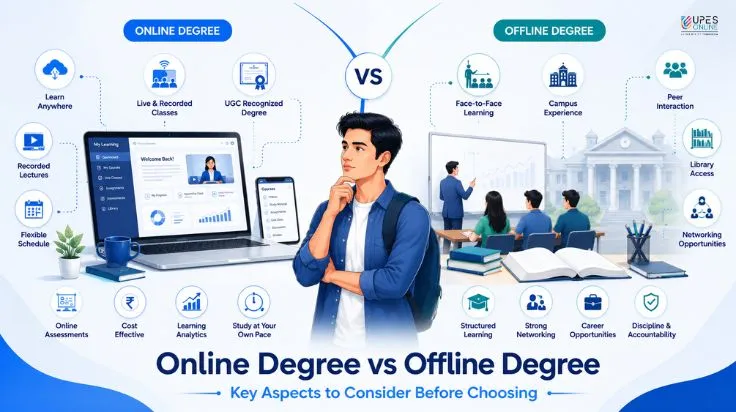
Online Degree vs Offline Degree: Key Aspects to Consider Before Choosing
Compare online degree vs offline degree based on flexibility, costs, career opportunities, recognition, & learning experience to choose the right program.
Read MoreJul 10, 2026 I 9 mins
Online B.Com Scope in 2026: Benefits, Careers, Salaries & Is It Worth It?
Explore online B.Com scope in 2026, including benefits, career options, salaries, industries, higher studies and whether an online B.Com degree is worth it.
Read MoreJul 31, 2026 I 11 mins
MBA for Working Professionals: Eligibility, Fees, Specializations & Career Scope
Explore a detailed guide on MBA for working professionals including eligibility, fees, online MBA options, top specializations, career scope & how to apply.
Read MoreAug 15, 2026 I 13 mins
Is Online MCA Worth It in 2026? Fees, Eligibility, Jobs & Colleges
Find out whether an Online MCA is worth it in 2026. Explore eligibility, fees, specializations, colleges, career scope, salaries and UGC validity.
Read MoreAug 29, 2026 I 11 mins
Online MBA for Engineers: Specializations & Career Scope
Find out if online MBA for engineers is a good choice; explore top specializations and career scope.
Read MoreSep 8, 2026 I 11 mins
Related Articles

Embracing the Digital Age: Why an MBA in Digital Business is a Must-Have
Staying ahead and at pace in this digital age makes an MBA in digital business an essential high education course.
Read Blog
Types of Startups, Business Models and Funding
Dive deep into the world of startups: Types, models, funding secrets, who invests & what's trending. Learns the basics of entrepreneurship.
Read Blog
Level Up Your Online MBA: Networking Tips for Success
Master virtual networking in an online mba program and learn types of business networking. Online MBA is the future.
Read BlogEmbracing the Digital Age: Why an MBA in Digital Business is a Must-Have
Staying ahead and at pace in this digital age makes an MBA in digital business an essential high education course.
Read BlogTypes of Startups, Business Models and Funding
Dive deep into the world of startups: Types, models, funding secrets, who invests & what's trending. Learns the basics of entrepreneurship.
Read BlogLevel Up Your Online MBA: Networking Tips for Success
Master virtual networking in an online mba program and learn types of business networking. Online MBA is the future.
Read BlogEmbracing the Digital Age: Why an MBA in Digital Business is a Must-Have
Staying ahead and at pace in this digital age makes an MBA in digital business an essential high education course.
Read Blog