Courses
MBA
MCA
BBA
BCA
B.Com
Certifications
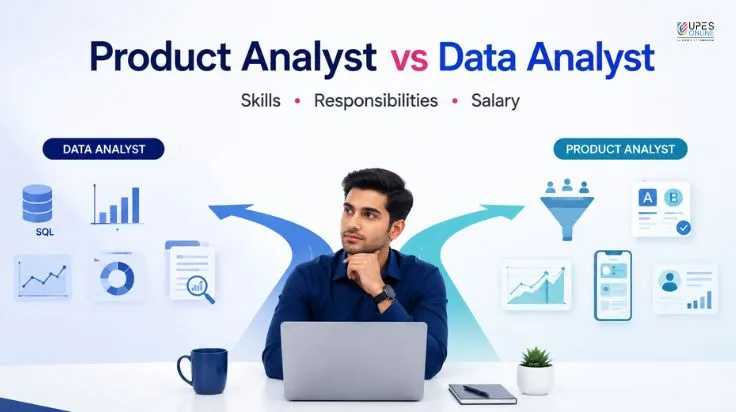
Choosing a career in the data domain often feels like standing at a crossroads with multiple signs pointing in similar directions. You know you want to work with numbers, but should you focus on the "product" or the "data" itself?
The confusion is real. While both roles rely on similar tools like SQL and Python, they operate with different mindsets. If you are a student or a young professional in India looking to break into the tech industry, understanding the nuance of product analyst vs data analyst is crucial for your long term growth.
In this guide, we will break down the differences in skills, responsibilities, and salaries to help you decide which path aligns with your personality and career goals.
A data analyst examines information across business functions to improve reporting, efficiency and decision-making. A product analyst focuses on how users interact with a specific digital product, using funnels, experiments and behavioural metrics to improve adoption, retention and growth. Data analysis is broader; product analytics is more specialised around product performance and user experience.
Before we dive into the technicalities, let's establish a clear definition for each role to set the stage.
While the foundational tools overlap, the application of these skills differs significantly between the two roles.
Both roles require a strong grip on data manipulation tools. If you are looking to build these from scratch, programs like the BCA in Data Analytics provide an excellent foundation in these core areas.
This is where the product analyst vs data analyst comparison starts to diverge. A product analyst needs specific "product-first" skills:
What does a typical Tuesday look like for these professionals? The day-to-day tasks highlight the functional differences.
| Feature | Data Analyst | Product Analyst |
|---|---|---|
| Primary Goal | Business Efficiency | Product Growth & UX |
| Main Stakeholders | Finance, HR, Marketing | Product Managers, UX Designers |
| Typical Question | How much did we sell in Q3? | Why did users stop using the 'Search' bar? |
| Key Tools | SQL, Excel, Power BI | SQL, Mixpanel, Amplitude, Python |
| Key strength | Business and reporting analysis | Product thinking and user-behaviour analysis |
| Typical progression | Senior Analyst, Analytics Manager, Data Scientist | Senior Product Analyst, Product Manager, Growth Lead |
In the Indian job market, both roles are highly lucrative, but specialization often commands a premium. As organizations invest more heavily in data-informed product and business decisions, professionals who combine analytics, experimentation and commercial understanding can command stronger compensation
For a fresher entering the field, the salary is quite competitive.
Because this is a specialized role often found in high-growth tech startups and MNCs, the starting packages can be slightly higher.
Salary disclaimer: Salaries vary based on the city (Bangalore and Gurgaon typically pay more) and the company's scale and is collected from various sources across the web in 2026.
If you enjoy big-picture thinking and want to help an entire organization run smoother, the Data Analyst path is a fantastic entry point. However, if you are obsessed with apps, user experience, and "building" things, then Product Analytics will be more fulfilling.
The good news is that you don't have to choose permanently today. You can start with a broad education and specialize later. For working professionals or graduates looking to pivot, the Post Graduate Certificate Program in Data Analytics by UPES Online offers a flexible, hybrid way to master these tools without pausing your career.
Neither role is universally better. Data analysis suits professionals who want to work across business functions and develop broad analytical expertise. Product analytics suits those interested in digital products, user behaviour, experimentation and product growth. Product analysts may earn more in product-led technology companies, but role fit and skill depth matter more than the title alone.
When comparing product analyst vs data analyst, remember that both roles are pillars of the modern digital economy. One focuses on the health of the business, while the other focuses on the heartbeat of the product.
If you are just starting out after the 12th grade, a structured degree like the UPES Online BCA in Data Analytics can give you the three-year runway needed to master both domains. For those already in the workforce, a six-to-ten month Post Graduate Certificate can provide the technical edge to negotiate a higher salary.
Don't let the "analysis paralysis" stop you. Whether you choose the product or the data, the future is undeniably data-driven.




Choose the best online MBA programs at UPES Online. Learn about specializations, career scope, & why professionals choose UPES for flexible learning.
Read MoreOct 15, 2025 I 6 mins
General MBA vs specialized MBA compared on metrics like scope, ROI, salary & career growth in India. Understand the path & choose wisely.
Read MoreMay 3, 2026 I 8 mins
Compare online degree vs offline degree based on flexibility, costs, career opportunities, recognition, & learning experience to choose the right program.
Read MoreJul 10, 2026 I 9 mins
Explore online B.Com scope in 2026, including benefits, career options, salaries, industries, higher studies and whether an online B.Com degree is worth it.
Read MoreJul 31, 2026 I 11 mins
Explore a detailed guide on MBA for working professionals including eligibility, fees, online MBA options, top specializations, career scope & how to apply.
Read MoreAug 15, 2026 I 13 mins
Find out whether an Online MCA is worth it in 2026. Explore eligibility, fees, specializations, colleges, career scope, salaries and UGC validity.
Read MoreAug 29, 2026 I 11 mins
Find out if online MBA for engineers is a good choice; explore top specializations and career scope.
Read MoreSep 8, 2026 I 11 mins
Choose 15 best data analytics jobs for freshers & professionals. Learn roles, skills, salaries to build a rewarding career in analytics.
Read Blog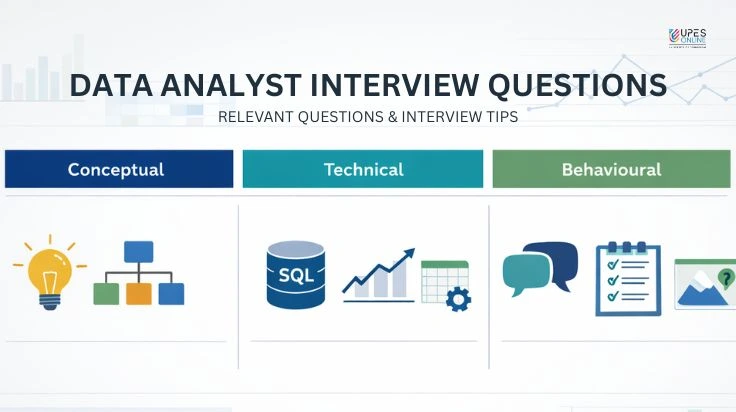
Prepare confidently with most important Data Analyst Interview Questions covering conceptual, SQL, Python, statistics, behavioural scenarios & fresher to advanced-level Qs.
Read Blog
Discover impactful data analytics projects to work on in 2026. Gain hands-on insights into predictive modeling, AI, & real-world data applications.
Read BlogChoose 15 best data analytics jobs for freshers & professionals. Learn roles, skills, salaries to build a rewarding career in analytics.
Read BlogPrepare confidently with most important Data Analyst Interview Questions covering conceptual, SQL, Python, statistics, behavioural scenarios & fresher to advanced-level Qs.
Read BlogDiscover impactful data analytics projects to work on in 2026. Gain hands-on insights into predictive modeling, AI, & real-world data applications.
Read BlogChoose 15 best data analytics jobs for freshers & professionals. Learn roles, skills, salaries to build a rewarding career in analytics.
Read Blog