
 Call Now
 Programs
  About
About 

Carbon Credits in India: Pricing, Trading, Careers, and How to Participate
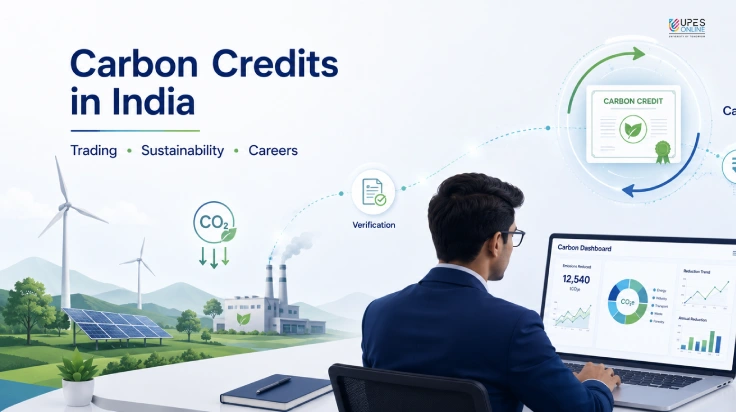
If you’ve searched carbon credits in India, you’ve probably seen three things at once: big climate claims, confusing jargon, and wildly different “price” numbers. That’s because India is building a formal domestic carbon market while a large voluntary carbon market already exists, each with different rules, buyers, and risks. Once you separate those two, carbon credits become much easier to understand (and much harder to misuse).
What is Carbon credit?
A carbon credit is a tradable certificate that usually represents 1 metric tonne of CO₂-equivalent (tCO₂e) reduced, avoided, or removed from the atmosphere—measured using a defined methodology, monitored over time, and verified by independent auditors. Credits are then sold to buyers (to meet compliance needs or voluntary climate commitments) or retired to claim an impact.
| Topic | Summary |
|---|---|
| What is it? | Tradable emission reduction certificate |
| One Credit | 1 tonne CO₂e |
| Used By | Governments & Businesses |
| Markets | Compliance & Voluntary |
| Careers | ESG, Carbon Markets, Sustainability |
| Future | Rapidly Growing |
Carbon credits market in India
India’s policy direction is toward an Indian Carbon Market (ICM) under the Carbon Credit Trading Scheme (CCTS), with an institutional setup that includes a national steering committee; Bureau of Energy Efficiency (BEE) as the Administrator; and Grid India functioning as the Registry. The framework also includes a Compliance Mechanism and an Offset Mechanism.
At the same time, many Indian projects already participate in voluntary carbon markets (VCMs), where credits are issued under standards like Verra’s VCS or Gold Standard, and sold to voluntary buyers. The important mental model
- Compliance market: rules set by government; obligated entities must meet targets; credits can be used for compliance.
- Voluntary market: companies/individuals buy credits voluntarily (often for net-zero claims); quality depends heavily on the standard + project integrity.
A practical comparison table (so you stop mixing things up)
| What you’re comparing | Compliance Mechanism (under CCTS/ICM) | Offset Mechanism (under CCTS/ICM) | Voluntary Carbon Market (VCM) |
|---|---|---|---|
| Who participates | “Obligated entities” (large emitters covered by scheme) | Non-obligated entities can generate offsets | Any eligible project developer + voluntary buyers |
| What drives demand | Meeting government-notified targets | Buyers needing offsets (and rules of the mechanism) | Corporate climate goals, claims, ESG strategies |
| Who runs it (India) | BEE as Administrator; Grid India as Registry; national steering committee oversight | Same umbrella framework | International/independent standards + registries |
| Where trading happens | Carbon Credit Certificates can be traded on power exchanges; CERC oversees trading regulation | Pathway for offsets within the domestic system | Registries + brokers/OTC marketplaces |
| What “counts” | Depends on notified rules, MRV and targets | Depends on offset procedures and methodologies | Depends on standard, methodology, verification, and buyer acceptance |
(Reality check: details evolve as India’s market moves from framework → scale. Always verify latest notifications.)
How to get carbon credits in India
People often ask how to get carbon credits in India or how to earn carbon credits in India as if you “apply and receive them.” In practice, credits are earned by running a project that can prove measurable emission reductions/removals under a rulebook.
Step-by-step: How to register for carbon credits in India
- Pick an eligible project type (renewables, energy efficiency, waste, AFOLU, etc., depending on the mechanism/standard).
- Choose the route: CCTS Offset Mechanism vs a voluntary standard (e.g., Verra/Gold Standard) based on buyer needs and rules.
- Design the project properly: baseline, additionality logic, monitoring plan, leakage/permanence risks.
- Validation by an approved third party (VVB/auditor) before registration.
- Register the project on the chosen registry (domestic or voluntary).
- Monitor results over time and prepare monitoring reports.
- Verification by an independent auditor, then issuance of credits to your account.
- Sell or retire credits depending on buyer/claim requirements.
A timeline reality check: validation can take many months (sometimes longer), and review cycles depend on documentation quality and auditor capacity.
How to sell carbon credits in India
If you’re searching how to sell carbon credits in India, focus on sellability—not just issuance.
- Prove ownership and “right to sell”
- Credits are assets. Buyers will ask who owns the project, land/technology rights, and whether any partner already has claim over the reductions.
- Credits are assets. Buyers will ask who owns the project, land/technology rights, and whether any partner already has claim over the reductions.
- Match your credit type to the buyer’s use case
- Some buyers need certain standards/methodologies; others care about SDG co-benefits; some will avoid specific categories due to integrity concerns (more on this below).
- Some buyers need certain standards/methodologies; others care about SDG co-benefits; some will avoid specific categories due to integrity concerns (more on this below).
- Choose a sales channel:
- Registry transfer / retirement (common in VCMs)
- Broker/OTC sale (price negotiated; diligence-heavy)
- Domestic exchange trading (relevant as CCTS trading scales via power exchanges)
- Avoid over-claiming
- Even if a credit is issued, marketing language can create reputational/legal risk for the buyer. Serious buyers now scrutinize claims and documentation.
Carbon credits trading in India: what “trading” actually means
Under India’s framework, trading of Carbon Credit Certificates is envisaged on power exchanges, with the Central Electricity Regulatory Commission (CERC) as the primary regulator overseeing trading on exchanges.
That’s different from how voluntary credits move, where credits are typically:
- issued into a registry account, then
- transferred to a buyer or retired to make a climate claim.
Carbon credits price in India
Search carbon credits price in India and you’ll find single-number answers. Treat those as marketing, not market reality.
What really drives the price of carbon credits in India
- Which market? Compliance price discovery vs voluntary negotiated pricing.
- Project type and risk: removals vs avoidance, permanence risk, leakage risk, monitoring complexity.
- Standard/methodology acceptance: some buyers will pay more for credits they can defend publicly.
- Vintage and traceability: newer credits with better MRV often face fewer objections.
- Broader market conditions: globally, supply and demand dynamics have been volatile, and integrity scrutiny has increased.
For early expectations around an Indian compliance price, industry commentary has pointed to a starting range around ~$10/mtCO₂e when the scheme commences at scale but treat this as an expectation, not a guaranteed benchmark.
Carbon Credits vs Carbon Offsets
| Carbon Credit | Carbon Offset |
|---|---|
| Tradable certificate | Emission reduction activity |
| Used in compliance & voluntary markets | Mainly voluntary claims |
| Represents 1 tCO₂e | Project generating reductions |
Career pathways in carbon markets (India): roles, skills, salary signals
Common job families:
- Sustainability / ESG Analyst (reporting, disclosures, climate strategy support)
- Carbon / MRV Analyst (data pipelines, emission factors, monitoring plans, audit readiness)
- Carbon Project Associate (project documentation, stakeholder coordination, verification cycles)
- Carbon Markets / Trading Analyst (market research, procurement, risk, compliance support)
A salary reality check: pay varies by city and company type, but for a Sustainability/ESG Analyst, reported ranges in India often land from mid-single-digit LPA to ~9 LPA+ for many roles, with higher bands for specialized or experienced profiles. (Glassdoor)
Skills that compound fast (and are teachable)
- Excel + basic statistics (non-negotiable)
- Carbon accounting literacy (Scopes, activity data, emission factors)
- MRV thinking: evidence trails, audit mindset
- Domain understanding: power, manufacturing, oil & gas, logistics, agriculture (choose one to go deep)
- Communication: translating messy emissions data into decisions
If your target is the energy sector (including oil & gas) and you want structured domain context—pricing, regulation, operations, and transition levers—an industry-aligned program can help. One option to explore is UPES Online’s MBA in Oil and Gas Management, especially if you’re aiming for energy-focused sustainability, carbon strategy, or compliance-adjacent roles.
Common mistakes people make with carbon credits (and how to fix them)
Listed below are some common mistakes people make with carbon credits. However, good thing you can fix them too! Read below to know more:
- Mistake: Treating carbon credits like a fixed-price commodity
- Fix: Always ask “which market, which standard, which project type, what verification quality?”
- Fix: Always ask “which market, which standard, which project type, what verification quality?”
- Mistake: Confusing “renewable energy” with “carbon credits”
- Fix: A solar plant can reduce emissions, but credits still require a methodology + monitoring + verification route.
- Fix: A solar plant can reduce emissions, but credits still require a methodology + monitoring + verification route.
- Mistake: Skipping additionality logic
- Fix: If the project would have happened anyway, many buyers will reject it or discount heavily.
- Fix: If the project would have happened anyway, many buyers will reject it or discount heavily.
- Mistake: Ignoring paperwork until a buyer shows up
- Fix: Build the evidence trail from day one. Auditor cycles are slow when documentation is weak.
- Fix: Build the evidence trail from day one. Auditor cycles are slow when documentation is weak.
- Mistake: Buying the cheapest credits for “net-zero” claims
- Fix: Cheap can become expensive if reputational risk hits. Integrity scrutiny is now a core part of the market.
Decision tool: which “carbon path” fits you in 2026?
Use this quick If…then… guide:
- If you don’t own a project or land, then your best path is career-first (ESG/MRV/project support).
- If you run a factory/plant, then look at compliance readiness + efficiency projects and explore how the domestic market affects targets and trading.
- If you’re a startup/farm collective/municipality, then explore offset-type projects (waste, agriculture, forestry, transport) but plan for verification capacity and timelines.
- If you’re thinking “investment”, then treat it as high-risk: price uncertainty, policy evolution, and integrity risk matter as much as demand.
List of companies buying carbon credits in India
A static “list” becomes outdated fast and can be misleading. A safer, more useful approach is to build a current list using these channels:
- Registry retirement data (who is retiring credits this quarter)
- Corporate sustainability reports (net-zero or carbon neutrality claims → check how they source credits)
- Carbon brokers/marketplaces (ask which sectors are actively procuring)
- Sectors with strong buyer activity often include tech, manufacturing, aviation value chains, and consumer brands—because they face stakeholder pressure and climate disclosures.
If your goal is to sell, this method is better than naming ten companies that may not be buying the type of credits you actually have.
Fees: one real example of a registry fee schedule in India (table)
If you’re comparing registration costs, it helps to see at least one published schedule. Carbon Registry–India (CR-I) publishes a fee schedule including account opening, annual maintenance, listing, registration, and issuance fees (per credit).
| CR-I fee item | Published fee (INR) |
|---|---|
| Account registration/opening | 25,000 |
| Annual maintenance | 15,000 |
| Project listing | 20,000 |
| Project registration (large scale) | 50,000 |
| Project registration (micro/small) | 20,000 |
| Issuance fee (per credit; tiered by volume) | starts at ₹5/credit for up to 1,000,000 credits |
Note: Beyond registry fees, projects often incur significant costs for validation/verification bodies and for measurement systems—budgeting should reflect that complexity.
FAQs (India-focused)
1) How to get carbon credits in India as an individual?
- Most individuals can’t “apply” for credits directly. You typically need a measurable emissions-reduction/removal project plus monitoring and third-party verification under a recognized mechanism or standard.
2) How to register for carbon credits in India?
- You register a project through a recognized registry/standard (voluntary) or through procedures under India’s domestic framework as it scales. The process involves project design, validation, monitoring, and verification before issuance.
3) What is the price of carbon credits in India?
- There isn’t one fixed price. Prices vary by market type (compliance vs voluntary), project type, verification quality, and buyer demand, with global market conditions influencing sentiment.
4) How to sell carbon credits in India?
- You’ll need clear credit ownership, verified issuance on a registry/recognized mechanism, and a buyer channel (registry transfer/retirement, broker, or exchange route as applicable). Strong documentation reduces delays.
5) Is carbon credits trading in India live?
- India has formulated the framework for the Indian Carbon Market under CCTS, with an institutional structure and pathways for trading on power exchanges under regulatory oversight. Market depth and liquidity will evolve with phased implementation.
6) How to invest in carbon credits in India?
- Retail “direct investment” in credits is not as straightforward as stocks. Many people get exposure indirectly (through sustainability-linked companies/projects) or via global instruments—while managing high policy and integrity risks.
7) Are carbon credits legit or a scam?
- Carbon credits can be legitimate, but quality varies widely. The credibility depends on methodology, monitoring, independent verification, and how claims are made—buyers increasingly demand stronger integrity evidence.
8) How big is India’s experience in carbon markets already?
- India has been a major supplier in voluntary markets historically; one analysis notes substantial issuance volumes over 2010–2022, indicating real project activity—along with challenges around timelines and participation patterns.
Action ahead
Those interested in this field can become proactive in the most productive of ways if they do the following steps listed below:
- Pick your lane (career, project development, corporate procurement, or research) using the If–then tool above.
- Download and read one official procedure (compliance or offset) to understand MRV expectations in India’s framework.
- Build one portfolio artifact: a 2-page mock monitoring plan or a simple emissions baseline model in Excel. This is what differentiates serious applicants in sustainability roles.
If you’re aiming for roles at the intersection of energy systems and carbon economics—especially in oil & gas and allied sectors—pairing carbon-market basics with structured energy-domain learning can make your profile sharper. Exploring an MBA track focused on oil & gas management is one way to build that context without switching careers overnight.
UPES Online Admission Enquiry
Recommended Courses


Latest Blogs
Online B.Com Scope in 2026: Benefits, Careers, Salaries & Is It Worth It?
Explore online B.Com scope in 2026, including benefits, career options, salaries, industries, higher studies and whether an online B.Com degree is worth it.
Read MoreJul 31, 2026 I 11 mins
MBA for Working Professionals: Eligibility, Fees, Specializations & Career Scope
Explore a detailed guide on MBA for working professionals including eligibility, fees, online MBA options, top specializations, career scope & how to apply.
Read MoreAug 15, 2026 I 13 mins
Is Online MCA Worth It in 2026? Fees, Eligibility, Jobs & Colleges
Find out whether an Online MCA is worth it in 2026. Explore eligibility, fees, specializations, colleges, career scope, salaries and UGC validity.
Read MoreAug 29, 2026 I 11 mins
Online MBA for Engineers: Specializations & Career Scope
Find out if online MBA for engineers is a good choice; explore top specializations and career scope.
Read MoreSep 8, 2026 I 11 mins
How to Identify Online Fake Universities & Degree Scams
Check the UGC fake university list 2026 and learn how to verify an online university, course entitlement, and whether a degree certificate is original or fake.
Read MoreSep 23, 2026 I 10 mins
How to Become a Project Manager with Online MBA in India: Detailed Guide
Learn how to become a project manager in India, including qualifications, skills, certifications, salary, career path & how an Online MBA can support it.
Read MoreSep 28, 2026 I 10 mins
Top Reasons to Pursue Online MBA in Finance
Explore top 10 benefits of an online MBA in Finance, including flexibility, finance skills, career opportunities, salaries, and who should pursue it.
Read MoreSep 29, 2026 I 10 mins
Related Articles
Beyond Fossil Fuels: Clean Energy Sources You Need to Know
Learn about the latest innovations & technologies driving the transition to clean energy and discover how you can make a positive impact on the environment.
Read Blog
The Dark Side of Renewable Energy: Myths and Misconceptions Debunked
Uncover the surprising truth about renewable energy! Learn about the myths & misconceptions surrounding it in our latest blog.
Read Blog
Sustainable Energy: Myth or Reality for Oil & Gas?
Economic growth in the oil and gas industry can be sustainable by making emissions, energy usage wise & environmental protection, imperative.
Read BlogBeyond Fossil Fuels: Clean Energy Sources You Need to Know
Learn about the latest innovations & technologies driving the transition to clean energy and discover how you can make a positive impact on the environment.
Read BlogThe Dark Side of Renewable Energy: Myths and Misconceptions Debunked
Uncover the surprising truth about renewable energy! Learn about the myths & misconceptions surrounding it in our latest blog.
Read BlogSustainable Energy: Myth or Reality for Oil & Gas?
Economic growth in the oil and gas industry can be sustainable by making emissions, energy usage wise & environmental protection, imperative.
Read BlogBeyond Fossil Fuels: Clean Energy Sources You Need to Know
Learn about the latest innovations & technologies driving the transition to clean energy and discover how you can make a positive impact on the environment.
Read Blog