Courses
MBA
MCA
BBA
BCA
B.Com
Certifications
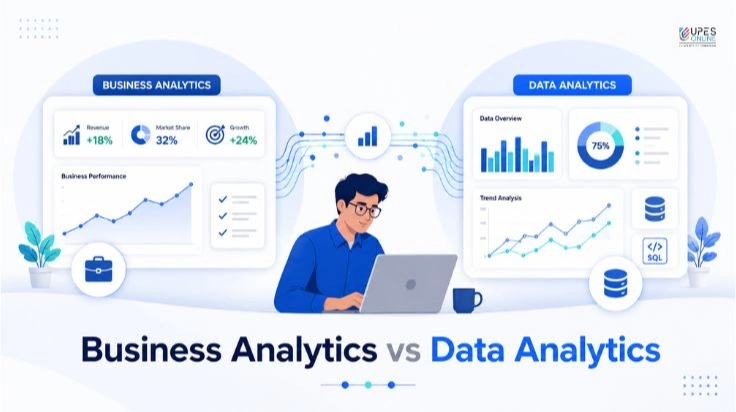
If you’re stuck choosing between business analytics vs data analytics, you’re not alone. The names sound similar, job titles overlap, and every course brochure claims “high demand”.
Here’s the simplest way to think about it: data analytics is closer to the data (collecting, cleaning, analysing), while business analytics is closer to decisions (solving business problems, choosing what to measure, and turning insights into actions). (Coursera). In practice, the two fields overlap significantly.
In this blog, you’ll get:
Where programs like UPES Online’s MBA (Business Analytics) and BCA (Data Analytics) fit naturally into your career path
In one line:
| Factor | Data Analytics | Business Analytics |
|---|---|---|
| Primary focus | Data → insights | Insights → decisions/results |
| Common outputs | Analyses, dashboards, reports, trends | Recommendations, forecasts, scenarios, business cases |
| Core Skills | SQL, Excel, statistics, visualisation, Python | Analytics, business knowledge, KPIs, communication, decision-making |
| Core tools | Excel, SQL, Python/R, Tableau/Power BI | Excel, SQL, Power BI/Tableau, statistical/analytics tools |
| Career direction | Analyst → Senior Analyst → Lead/Manager | BA → Product/Strategy/Analytics Manager |
| Business interaction | Moderate to high | Usually high |
| Technical depth | Usually higher | Varies significantly by role |
| Good fit for | People who enjoy data and technical problem-solving | People who enjoy data-driven business problem-solving |
Business analytics is using data + analytical methods to solve business problems—like improving revenue, reducing churn, reducing fraud, optimising supply chain, or increasing conversions.
1. Descriptive Analytics
2. Diagnostic Analytics
3. Predictive Analytics
4. Prescriptive Analytics
Example (simple)
Data analytics is the process of collecting, cleaning, analysing, and visualising data to answer questions and find patterns.
A data analytics role often involves:
Example (simple)
No. Business Analytics is a field that uses data and analytical methods to improve business decisions, while Business Analyst is a job role that often focuses on business requirements, processes, stakeholders and solutions. Some Business Analysts work extensively with data, while others focus more on process and requirements analysis.
Here are the differences that change your day-to-day work (not just definitions):
Ai is enhancing both analytics fields by automating repetitive tasks and helping professionals analyse information faster. In Data Analytics, AI can assist with data cleaning, query generation, anomaly detection, visualisation and pattern discovery. In Business Analytics, AI can support forecasting, scenario analysis, KPI monitoring, decision support and natural-language exploration of business data.
| AI application | Data Analytics | Business Analytics |
|---|---|---|
| Data cleaning | High relevance | Supporting |
| SQL/query assistance | High | Moderate |
| Anomaly detection | High | High |
| Forecasting | High | High |
| Dashboard summaries | High | High |
| Scenario analysis | Moderate | High |
| Business recommendations | Supporting | High |
| Natural-language analytics | High | High |
Let us delve into the career opportunities available to Business and Data Analytics:
Job titles are not standardised across employers. Business Data Analyst and Product Analyst often sit in the middle: you need both analysis + decision storytelling and may perform work that spans both.
| Task | Data Analyst | Business Analytics Professional |
|---|---|---|
| Write SQL queries | Frequently | Sometimes/frequently |
| Clean datasets | Frequently | Sometimes |
| Build dashboards | Frequently | Frequently |
| Define KPIs | Sometimes | Frequently |
| Meet stakeholders | Frequently | Very Frequently |
| Investigate business problems | Frequently | Very Frequently |
| Build business cases | Sometimes | Frequently |
| Present recommendations | Frequently | Very frequently |
| Statistical modelling | Depends on role | Depends on role |
Both roles require specific skills and strengths as listed below:
There isn’t a universal “better”. The better choice depends on your personality + career destination.
You’ll enjoy it if: you like logic, patterns, building things, and “show me the data”.
You’ll enjoy it if: you like explaining, influencing, prioritising, and solving ambiguous problems.
Ask yourself: Where do you want to be in 3 years?
Salaries vary a lot by city, company type (startup vs enterprise), and your tool depth. But to make this concrete, here are recent India estimates from Glassdoor.
| Career track | Representative role | Indicative India salary |
|---|---|---|
| Data Analytics | Data Analyst | ~₹4.3L–₹10L (estimated) |
| Data Analytics / BI | BI Analyst | ~₹5.5L–₹12.3L (estimated) |
| Business Analytics | Business Analytics Analyst | ~₹5.7L–₹13.6L (estimated) |
| Hybrid | Product Analyst | ~₹13L–₹22L (estimated) |
| Senior BA | Analytics Manager | ~₹13L–₹22L (estimated) |
| Sources: Glassdoor Naukri, | ||
Note: Salary data shifts over time; these are platform-reported estimates, not guarantees.
| Industry | Common analytics applications |
|---|---|
| Banking & FinTech | Fraud, credit risk, customer analytics |
| E-commerce | Pricing, conversion, recommendations |
| Retail | Demand, inventory, customer behaviour |
| Healthcare | Operations, patient analytics |
| Manufacturing | Forecasting, quality, operations |
| Consulting | Business transformation and strategy |
| SaaS/Technology | Product usage, churn, growth |
| Telecom | Churn, network/customer analytics |
| Supply Chain | Demand, inventory, logistics |
If you’re asking “which is easy”, what you’re really asking is: which one matches my current strengths?
If you’re starting from zero:
Problem → Dataset → Method → Insight → Recommendation → Business impact
If you want a guided path that blends programming + analytics foundations, exploring a structured BCA curriculum can reduce the “what do I learn first?” confusion.
Your choice is dependent on various factors. Have a look at some:
Pick Data Analytics if you want:
Pick Business Analytics if you want:
And if you’re still unsure:
Start with data analytics foundations (Excel + SQL + BI). Even business analytics roles respect you more when you can pull and validate data yourself.
1) Is business analytics the same as business analyst?
2) Do I need coding for data analytics?
3) Which has higher salary: business analytics or data analytics?
4) Can a BCA in Data Analytics lead to MBA in Business Analytics?
5) Can You Switch from Data Analytics to Business Analytics?
6) What’s the best tool to learn first?
7) Is data analytics a good career in India in 2026?
8) What should I build for a portfolio?
Choosing between business analytics vs data analytics is less about labels and more about where you want to sit in the workflow:
If you’re confused, that’s normal- these fields overlap in the real world. But action beats confusion: pick one track, build 2–4 solid projects, and your clarity will increase faster than any “perfect choice” research loop.
If you want a structured pathway, you can explore:




Choose the best online MBA programs at UPES Online. Learn about specializations, career scope, & why professionals choose UPES for flexible learning.
Read MoreOct 15, 2025 I 6 mins
General MBA vs specialized MBA compared on metrics like scope, ROI, salary & career growth in India. Understand the path & choose wisely.
Read MoreMay 3, 2026 I 8 mins
Compare online degree vs offline degree based on flexibility, costs, career opportunities, recognition, & learning experience to choose the right program.
Read MoreJul 10, 2026 I 9 mins
Explore online B.Com scope in 2026, including benefits, career options, salaries, industries, higher studies and whether an online B.Com degree is worth it.
Read MoreJul 31, 2026 I 11 mins
Explore a detailed guide on MBA for working professionals including eligibility, fees, online MBA options, top specializations, career scope & how to apply.
Read MoreAug 15, 2026 I 13 mins
Find out whether an Online MCA is worth it in 2026. Explore eligibility, fees, specializations, colleges, career scope, salaries and UGC validity.
Read MoreAug 29, 2026 I 11 mins
Find out if online MBA for engineers is a good choice; explore top specializations and career scope.
Read MoreSep 8, 2026 I 11 mins
Learn types of prescriptive techniques & examples of prescriptive analytics to make data analytics & business analysis a detailed & accurate process.
Read Blog
Learn the importance of predictive analysis in a dynamic business environment with examples and tools for predictive analysis.
Read Blog
Discover latest data analytics techniques & tools to extract meaningful information from complex data sets & make data-driven decisions.
Read Blog
In this blog find answers to what is web analytics? What is web analytics process? What is the importance of website analytics?
Read Blog
Learn about successful techniques & tools for text mining, text analytics & types of text analytics to derive most insightful data interpretations.
Read BlogLearn types of prescriptive techniques & examples of prescriptive analytics to make data analytics & business analysis a detailed & accurate process.
Read BlogLearn the importance of predictive analysis in a dynamic business environment with examples and tools for predictive analysis.
Read BlogDiscover latest data analytics techniques & tools to extract meaningful information from complex data sets & make data-driven decisions.
Read BlogIn this blog find answers to what is web analytics? What is web analytics process? What is the importance of website analytics?
Read BlogLearn about successful techniques & tools for text mining, text analytics & types of text analytics to derive most insightful data interpretations.
Read BlogLearn types of prescriptive techniques & examples of prescriptive analytics to make data analytics & business analysis a detailed & accurate process.
Read Blog